
TechInsiderz.com Gadgets Review 2026 The Best Tech Worth Your Money This Year

If you’ve tried to buy a gadget this year, you already know the problem: every category has exploded. Smartwatches now double as health labs, smart glasses are creeping out of novelty territory, and “AI-powered” is stamped on everything from toothbrushes to power banks. That’s exactly why this TechInsiderz.com Gadgets Review 2026 exists to cut through the marketing noise and tell you what’s genuinely worth your money.
We’re not chasing every product launch. Instead, this guide focuses on the categories readers actually search for smartphones, wearables, smart glasses, smart home devices, audio, and charging tech and explains why certain picks stand out in 2026, not just that they exist. You’ll get real trade-offs, not spec-sheet copy-paste.
By the end, you’ll know which gadget categories matter for your lifestyle, what’s genuinely new this year versus recycled marketing language, and how to avoid the most common (and expensive) buying mistakes. Let’s start with what’s actually changed in the gadget world this year.
What’s Actually New in Tech for 2026
Gadget hype cycles repeat themselves every January, but a few shifts this year are real rather than recycled:
- On-device AI is now standard, not a premium feature. Chips like Qualcomm’s Snapdragon Wear Elite push AI processing directly onto wearables instead of relying on the cloud, which means <cite index=”9-1″>faster response times for everyday interactions</cite> and better privacy since less data leaves the device.
- Smart glasses are moving from gimmick to daily tool. Industry coverage this year notes that <cite index=”12-1″>smart glasses are transitioning from a niche hobby into a high-frequency tool</cite> as brands compete to become people’s primary mobile screen.
- Health wearables are getting smarter, not just more sensors. AI fitness bands are evolving <cite index=”12-1″>from simple pedometers into wearable health assistants</cite> that track heart rate variability, skin temperature, and recovery though inconsistent algorithms across brands remain a real complaint worth knowing about before you buy.
- Design restraint is back. Reviewers testing this year’s crop of gadgets are specifically calling out products that <cite index=”11-1″>challenge a category assumption</cite> rather than just adding more features thinner power banks, cleaner smartwatch bezels, and simpler interfaces.
That last point matters more than most buying guides admit: bigger spec sheets don’t automatically mean a better gadget. Keep that in mind as you go through the categories below.
Key Takeaways
- 2026’s real gadget shift is on-device AI and smarter design, not just longer spec lists.
- Smartwatches and smart rings serve different needs choose based on lifestyle, not hype.
- Smart glasses are promising but still priced for early adopters.
- Software update length and subscription costs matter as much as the upfront price.
- The best gadget for you is the one that fits your existing ecosystem and actual daily habits not necessarily the one with the best review score in isolation.
Also Post: HearthStats Net News: What It Is and What to Know (2026)
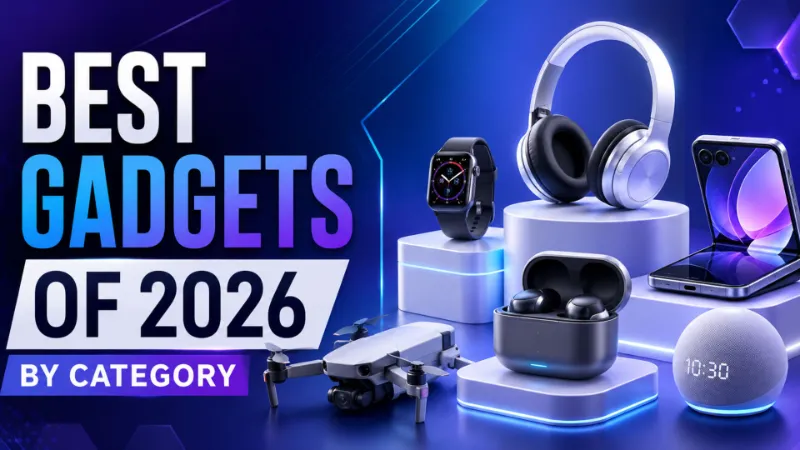
Best Gadgets of 2026, by Category
Smartphones & Foldables
Smartphones remain the most-researched gadget category, and for good reason it’s the device most people use hardest, every day. In 2026, the flagship conversation isn’t really about raw specs anymore; it’s about camera AI processing, battery efficiency under sustained use, and how many years of software updates you’re actually getting.
What to look for:
- Real-world camera performance across lighting conditions, not marketing megapixel counts
- Confirmed software update commitment (4+ years is now a reasonable minimum ask)
- Battery health degradation data if you plan to keep the phone 2+ years
- Repairability a growing decision factor as consumers hold onto devices longer
Wearables: Smartwatches, Smart Rings & Health Trackers
This category has split into two clear lanes. Smartwatches like recent Pixel Watch and Galaxy Watch generations lean into large displays and deep app ecosystems, while smart rings trade screen size for discretion and multi-day battery life.
| Wearable Type | Best For | Typical Battery Life | Trade-off |
|---|---|---|---|
| Smartwatch | Notifications, apps, GPS, larger display | 1–2 days | Needs daily charging |
| Smart ring | Sleep tracking, discretion, minimal upkeep | 4–7 days | No display, fewer features |
| Fitness band | Budget activity tracking | 5–7 days | Basic feature set |
| Wearable ECG | Cardiovascular monitoring | Varies by device | Not a diagnostic replacement |
A design detail worth knowing: some 2026 smartwatches have made real jumps in screen quality — for example, this year’s Xiaomi Watch S5 pushes a <cite index=”11-1″>1.48-inch AMOLED display running at 2,500 nits peak brightness with a notably narrower bezel</cite> than its predecessor, which shows how much attention manufacturers are now paying to the feel of a device, not just its sensor list.
Our honest take: if you already own a phone from a specific ecosystem (Apple, Samsung, Google), staying within that ecosystem for your wearable will almost always give you a smoother experience than chasing the “best” wearable on paper.
Smart Glasses & AR/VR
This is the category to watch in 2026. Reviewers who’ve tested extensively this year have singled out newer smart glasses as genuine standouts rather than novelty items, largely because of improvements in field of view, weight distribution, and battery efficiency. Pricing across the segment still runs roughly $500–$2,000 depending on features, so this remains an early-adopter category rather than a mainstream must-buy — but it’s closing that gap faster than expected.
Smart Home & Security
Smart home tech in 2026 is less about adding more devices and more about making existing ones talk to each other properly. The biggest complaints in this space are still fragmented apps and inconsistent voice assistant behavior across brands something to test in-store or read multiple reviews about before committing to an ecosystem.
What actually matters when buying smart home gadgets:
- Local processing options (reduces cloud dependency and privacy risk)
- Cross-platform compatibility (Matter/Thread support)
- Subscription costs for cloud storage (often the real long-term cost)
- Setup difficulty for non-technical household members
Charging & Power Accessories
An unglamorous category that quietly matters most: GaN (gallium nitride) chargers and slimmer power banks are having a real design moment this year. This year’s product cycle has produced power banks built around <cite index=”11-1″>ten layers of protection covering overvoltage, overcurrent, overheating, and short circuits</cite>, alongside dual temperature sensors safety features that used to be reserved for premium devices and are now trickling down to mid-range products.
Audio: Earbuds, Headphones & Speakers
Wireless earbuds remain one of the highest-repeat-purchase gadget categories, largely because batteries degrade and preferences change. In 2026, the differentiators worth paying attention to are adaptive noise cancellation quality (not just marketing claims), multipoint Bluetooth connection for switching between devices, and case battery life the spec most reviews underreport.
Related Post: GlossyWise com Review (2026): Is It Legit, Safe, or a Content Farm?
TechInsiderz.com Gadget Buying Guide 2026: How to Choose Without Overspending

Most buying mistakes don’t come from picking a “bad” gadget they come from picking the wrong gadget for your actual habits. Use this quick framework:
- Identify your primary use case first. Work, fitness, content creation, or general daily use each point toward different priorities.
- Set a realistic budget band, not a single number. Mid-range devices in most categories now deliver 80–90% of flagship performance for meaningfully less money.
- Check software support length, especially for phones, watches, and smart home hubs — this determines how long the device stays secure and usable.
- Read multiple independent reviews, not just the manufacturer’s page or a single influencer video.
- Factor in the ecosystem you’re already in. A technically “better” device that doesn’t play well with your existing gadgets often creates more friction than it’s worth.
Common Mistakes to Avoid
- Buying on spec sheets alone. A device with impressive specs but poor software optimization often performs worse day-to-day than a “lesser” competitor.
- Ignoring update policies. A cheaper gadget that stops receiving security updates in a year isn’t actually cheaper.
- Assuming AI features are automatically useful. Some AI additions genuinely improve daily use; others are marketing dressing on a feature nobody asked for. Test before you commit where possible.
- Overlooking subscription costs. Smart home cameras and some health wearables quietly rely on monthly fees for full functionality factor that into the real price.
FAQ’s About TechInsiderz.com Gadgets
What are the biggest gadget trends for 2026?
On-device AI processing, smart glasses moving toward mainstream use, smarter (not just more numerous) health-tracking wearables, and a renewed focus on thinner, more efficient charging hardware are the standout trends this year.
Are smart rings better than smartwatches?
Neither is universally “better” it depends on your priorities. Smart rings win on discretion and battery life (typically 4–7 days), while smartwatches win on display size, app support, and features like GPS and contactless payment.
Is it worth buying smart glasses in 2026?
For most people, smart glasses are still an early-adopter purchase given current pricing (roughly $500–$2,000). They’re improving quickly, but mainstream affordability and app ecosystems aren’t fully there yet.
How long should a smartphone last before I need to upgrade?
With current software support commitments, a well-maintained flagship phone can reasonably last 4–5 years. Battery health and app performance, not just age, are the better indicators of when to upgrade.
Do AI-powered wearables actually improve health tracking?
They can, particularly for trends like resting heart rate and sleep quality over time. But accuracy varies by brand, and these devices should be treated as wellness tools, not diagnostic medical devices.
Conclusion
The gadget market in 2026 rewards buyers who ask better questions, not just bigger budgets. Whether you’re eyeing a new smartwatch, testing the smart glasses waters, or simply replacing a charger that’s finally given out, the products that hold up long-term are the ones built around real daily use not just an impressive spec sheet. That’s the standard this TechInsiderz.com Gadgets Review 2026 guide was built around, and it’s the standard worth applying before your next purchase.
Rameen Zara is the founder of Clarity Nooks, bringing over five years of experience in home décor and interior styling. She shares simple yet practical design ideas that suit real homes and everyday living. Her approach focuses on cozy aesthetics, soft color palettes, and natural textures that create warm, inviting spaces.