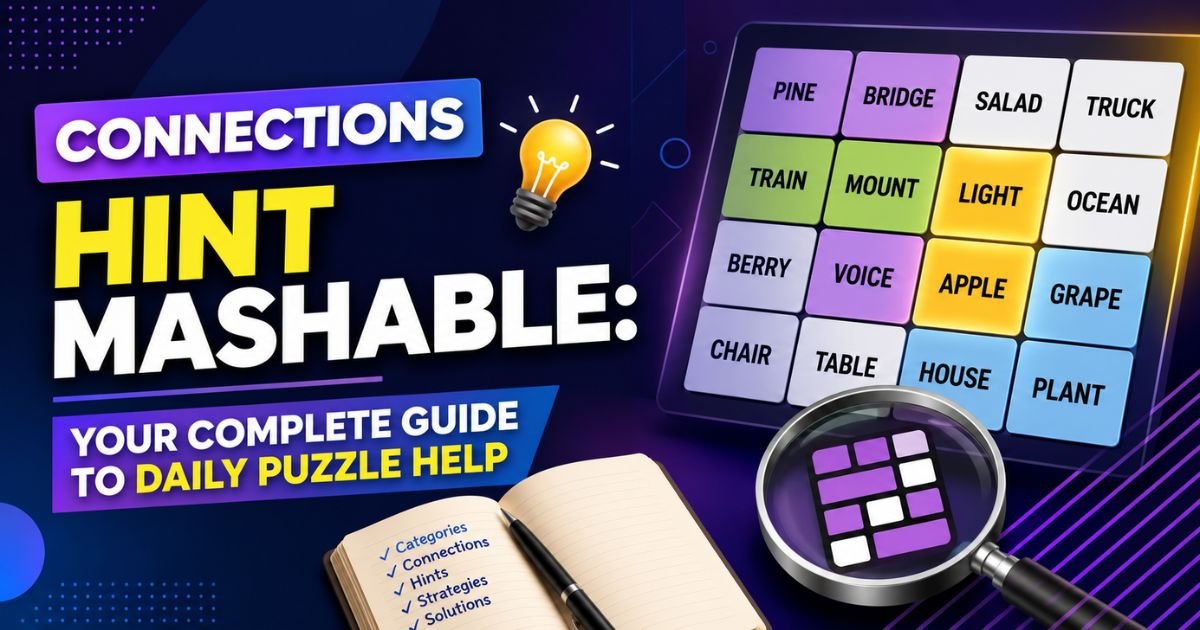
Connections Hint Mashable: Your Complete Guide to Daily Puzzle Help

If you play the NYT Connections game, you’ve probably searched for a Connections hint Mashable article at least once. Mashable publishes daily hints and answers for this popular word puzzle, and millions of players use it to get unstuck without fully spoiling the fun.
This guide explains what Connections Hint Mashable coverage actually offers, how the hint system works, and how you can use hints the smart way. You’ll also learn strategies to solve more puzzles on your own, so you rely on hints less over time.
What Is the NYT Connections Hint Mashable Game?
Connections is a daily word puzzle by The New York Times where you group 16 words into four hidden categories of four. Each category has a theme, and the trick is that some words seem to fit more than one group.
The game ranks categories by difficulty using colors:
- Yellow – easiest
- Green – slightly tricky
- Blue – harder
- Purple – hardest, often wordplay-based
You get four mistakes before the puzzle locks you out for the day. That limit is what makes hints so useful one wrong guess can cost you the win.
What Does “Connections Hint Mashable” Mean?
“Connections hint Mashable” refers to Mashable’s daily articles that give clues and answers for that day’s NYT Connections puzzle. Mashable is a well-known tech and culture website that publishes puzzle help for games like Wordle, Connections, and Strands.
Their Connections coverage usually includes:
- A general hint for each of the four categories
- The theme of each color group, without giving away every word
- The full answer list, placed further down the page for players who want it
- A short explanation of why each grouping works
This layered format lets you choose how much help you want. You can stop reading after the first hint, or scroll down for the complete solution.
Must Read This Article: Honest Reviews About Alaikas com 2026 Is It Legit or Just Cheap
How Connections Hints Mashable Work

Mashable structures its hints in stages, from vague clues to full answers, so you control how much you see. This is one reason the format has become so popular with daily puzzle fans.
A typical Mashable Connections article follows this order:
- Topic hint – A short sentence describing what one category is about, without naming words.
- Category theme reveal – The exact theme name for each color group (for example, “Types of Bread” or “___ Party”).
- Full answers – Every word listed under its correct category and color.
This step-by-step layout works well for both beginners who want a nudge and puzzle veterans who only want to check their answer at the end.
Where to Find Connections Hints Mashable
You can find Connections hints Mashable’s puzzle section, published fresh every day, usually before noon Eastern Time. Other sites also publish hints, so it helps to know your options.
Common sources include:
- Mashable’s dedicated Connections hint page
- The New York Times’ own Games section
- Other puzzle-focused blogs and forums like Reddit’s puzzle communities
If you want consistency, bookmarking one trusted source, such as Mashable, helps you avoid inconsistent hint quality across sites.
Don’t Miss This Post: The Serpent Rogue Competitive Edge: A Complete Strategy Guide
How to Use Hints Without Ruining the Puzzle
The best way to use a Connections hint is to read only the first clue, try the puzzle again, and save the full answer as a last resort. Going straight to the answer skips the problem-solving part that makes the game fun.
Here’s a simple approach:
- Play the puzzle first, without any hints.
- If you’re stuck, read only the topic hint for one category.
- Try again using that small clue.
- Repeat for each category only if needed.
- Use the full answer list only if you’re about to lose your last guess.
This method keeps the challenge alive while still helping you finish your streak.
Quick Hint-Reading Checklist
- Read one hint at a time, not all four at once
- Cover the answers below the fold until you truly need them
- Note which category type (yellow, green, blue, purple) usually trips you up
Proven Strategies to Solve Connections Faster
You can solve Connections faster by starting with the words you’re most confident about and watching out for words that seem to fit two categories. These strategies come from patterns seen across hundreds of daily puzzles.
1. Start With the Obvious Group
Look for four words that clearly share a theme, like colors, animals, or days of the week. This is often the yellow category.
2. Watch for Overlap Traps
Puzzle makers often place a word in the grid that looks like it belongs to two categories. For example, a word that could be a fruit or a slang term. Don’t lock in a guess until you’ve checked all 16 words.
3. Save Purple for Last
The purple category usually relies on wordplay, hidden phrases, or unusual connections. Solve the easier three groups first, and the last four words will often reveal themselves by elimination.
4. Use the “Shuffle” Button
Rearranging the tiles can help your brain spot patterns you missed the first time.
5. Think About Word Categories, Not Just Meaning
Some categories aren’t about meaning at all. They might be about words that can follow or precede a certain word, like “___ Cake” or “Fire ___.”
Read More: 5StarsStocks com: Review 2026 Is This AI Stock Picker Worth Trusting
Pros and Cons of Using Puzzle Hints
| Pros | Cons |
|---|---|
| Helps you finish your daily streak | Can reduce the challenge if overused |
| Teaches you new categorization patterns | May lead to guessing instead of reasoning |
| Useful for beginners learning the game | Full answers remove all suspense |
| Saves time on rushed mornings | Some hint sites post inconsistent quality |
Used in moderation, hints are a helpful tool. Used constantly, they can take away the mental workout that makes Connections popular in the first place.
Connections vs. Wordle vs. Other NYT Games
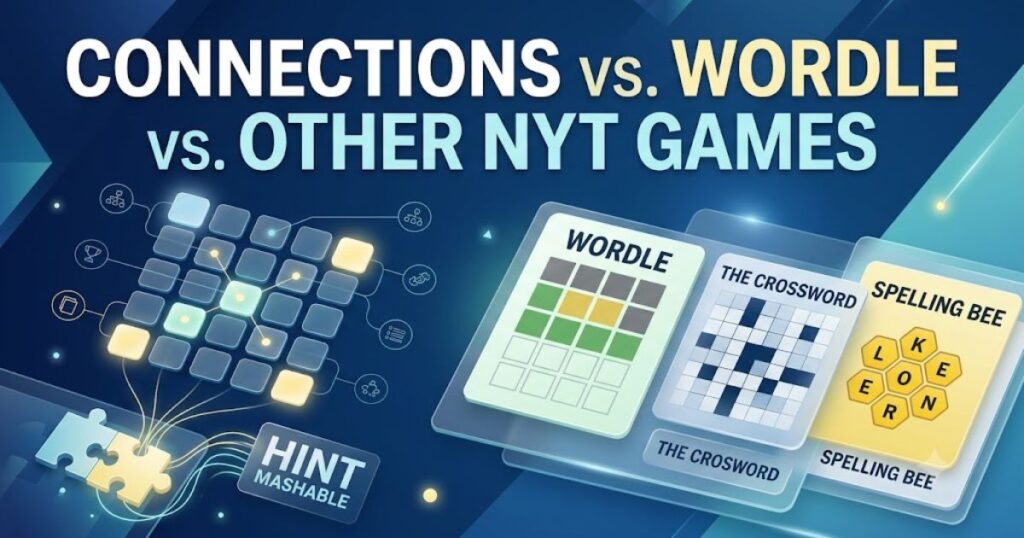
Connections differs from Wordle because it tests category recognition instead of letter-based guessing. Both are daily NYT games, but they use different skills.
| Feature | Connections | Wordle | Strands |
|---|---|---|---|
| Skill tested | Grouping & categories | Letter deduction | Word search & theme |
| Daily attempts | 4 mistakes allowed | 6 guesses allowed | Unlimited hints via “spangram” |
| Difficulty style | Color-coded (easy to hard) | Flat difficulty | Theme-based |
| Best for | Pattern thinkers | Vocabulary lovers | Word search fans |
If you enjoy Connections, you’ll likely enjoy Strands too, since both rely on spotting hidden themes rather than just vocabulary.
Common Mistakes Players Make
The most common Connections mistakes are guessing too fast, ignoring word overlaps, and locking in a group before checking all 16 words. Avoiding these errors saves your limited guesses.
- Guessing without scanning the full grid – Always read all 16 words before your first guess.
- Ignoring plural vs. singular clues – Some categories depend on exact word form.
- Forcing a connection that isn’t there – If a group feels forced, recheck it.
- Skipping the color pattern – Colors hint at difficulty, which can guide your order of solving.
- Reading the full answer too early – This removes the challenge and can make the habit less rewarding over time.
Expert Tips for Daily Players
- Play at the same time each day. This builds a habit and keeps your streak alive.
- Keep a mental note of past categories. The NYT rarely repeats exact groupings, but similar patterns show up over time.
- Don’t rush the first guess. Most mistakes happen in the first 30 seconds, before players have scanned the whole board.
- Use hints as a learning tool, not a shortcut. Read the hint, then try to reason out the rest yourself.
- Track your average mistake count. If you’re consistently using all 4 mistakes, slow down and read every word twice before guessing.
FAQs About Connections hint Mashable
What is a Connections hint Mashable?
A Connections hint on Mashable is a daily clue that describes one or more categories in the NYT Connections puzzle without giving the full answer right away.
Does Mashable post Connections answers every day?
Yes, Mashable typically publishes hints and full answers for the NYT Connections puzzle every day, usually in the morning Eastern Time.
Is it cheating to use a Connections hint Mashable?
No. Connections is a casual daily game, not a competitive test. Using a hint when you’re stuck is a common and accepted way to keep your streak going.
How many mistakes are allowed in Connections?
You get four mistakes per puzzle. After the fourth wrong guess, the puzzle locks and reveals the answers.
What do the colors mean in Connections?
Yellow is the easiest category, green is slightly harder, blue is more difficult, and purple is usually the hardest, often involving wordplay.
Can I play old Connections puzzles?
The New York Times does not officially offer an archive for older Connections puzzles on its main site, though some third-party tools track past puzzles.
Why does Mashable’s hint page not give the answer right away?
Mashable structures hints in stages, from vague to specific, so players can choose how much help they want before seeing the full solution.
Is Connections free to play?
Yes, Connections is free to play on the NYT Games website and app, though some NYT games are eventually placed behind a subscription for full access.
What time does the new Connections puzzle come out?
A new Connections puzzle is released daily at midnight Eastern Time.
Are there other sites besides Mashable that post Connections hints?
Yes. Other outlets and community forums also post daily Connections hints, but hint quality and clarity can vary between sources.
Why do I keep getting the same category wrong?
This usually means a word in that group also fits another category logically. Recheck all 16 words before guessing again.
Does using hints reduce my Connections streak?
No. Your streak is based on completing the puzzle, not on how you solved it. Using a hint does not break your streak.
Conclusion
A Connections hint Mashable article can be a helpful safety net when you’re stuck on a tricky category, especially on tougher puzzle days. The key is using hints wisely read just enough to get unstuck, then try to finish the reasoning yourself. Over time, this habit will sharpen your pattern-recognition skills, and you’ll find yourself needing hints less often.
Whether you’re new to the game or a daily streak-keeper, the goal is the same: enjoy the challenge, learn from each puzzle, and use hints as a tool, not a crutch.
Rameen Zara is the founder of Clarity Nooks, bringing over five years of experience in home décor and interior styling. She shares simple yet practical design ideas that suit real homes and everyday living. Her approach focuses on cozy aesthetics, soft color palettes, and natural textures that create warm, inviting spaces.