

The Serpent Rogue Competitive Edge: A Complete Strategy Guide

Getting a real Serpent Rogue competitive edge doesn’t come from fast reflexes or expensive gear. It comes from knowing the systems: alchemy, taming, and corruption control. This guide breaks down exactly how to build that edge, step by step, whether you’re starting your first run or trying to clean up a messy playstyle.
The Serpent Rogue is a game that punishes rushing and rewards patience. Once you understand that, everything else gets easier.
What Is The Serpent Rogue?
The Serpent Rogue is an action-adventure roguelike developed by Sengi Games and published by Team17. It launched on April 26, 2022, for Windows, PlayStation 5, Xbox Series X/S, and Nintendo Switch.
You play as the Warden, a plague-doctor-style alchemist and member of the Keepers, a group tasked with fighting a corrupting evil spreading across Mount Morbus. The setup sounds like a typical monster-hunting story, but the actual gameplay is closer to a survival crafting sim mixed with light combat.
You explore corrupted zones, gather ingredients, brew potions, tame creatures, and try to restore balance before a corruption storm wipes the area clean. Notably, Sengi Games is a Ukrainian studio, and the team chose to release the game as planned in April 2022, shortly after the start of the war in Ukraine.
Why Alchemy Is the Real Competitive Edge
Alchemy is the single biggest factor in your Serpent Rogue competitive edge, more than weapons, armor, or raw combat skill. The game is built around brewing potions that heal, transform, summon creatures, or weaken enemies.
Here’s why alchemy matters so much:
- Potions cover healing, offense, and utility in one system
- Ingredients are everywhere, so alchemy never runs dry
- Combat gear breaks down fast due to a strict durability system
- Smart brewing lets you skip fights you can’t win
Players who ignore alchemy tend to burn through weapons, run out of healing, and get stuck. Players who lean into it start solving problems instead of just surviving them.
Also Read: 5StarsStocks com: Review 2026 Is This AI Stock Picker Worth Trusting
The Core Gameplay Loop
Each run in The Serpent Rogue follows a simple pattern: prepare, explore, gather, craft, and retreat before time runs out.
Here’s what that looks like in practice:
- Start at your hub area, which has a smithy, alchemy table, and crafting bench
- Head into a corrupted zone
- Scavenge for ingredients, food, and crafting materials
- Research unknown ingredients at a lab to learn their properties
- Brew potions using what you’ve researched
- Deal with the corruption source or retreat before a storm hits
- Return to base, store your loot, and repeat with better gear
This loop repeats throughout the game, but the details change as new areas, ingredients, and threats appear. Treating every trip as a focused resource run, rather than a random adventure, is one of the simplest ways to build a lasting edge.
Combat Basics and Why Fighting Isn’t Always Smart

Combat in The Serpent Rogue is intentionally limited, and that’s the point. Weapons have durability that wears down fast, so treating every enemy as a fight to the death usually backfires.
A few basics worth knowing:
- Different tools work differently against enemies; not everything can be cut with a blade
- Blocking and dodging matter more than trading hits
- Attacking an enemy while they’re holding a healing item can accidentally heal them
- Running past a threat is often smarter than fighting it
Many new players treat this like a typical action game and get frustrated. Once you accept that combat is a last resort, not the main strategy, the game starts to feel a lot fairer.
Common Combat Mistake to Avoid
One mistake that trips up almost everyone early on: swinging at an enemy mid-heal. If you attack while they’re using a potion or healing item, that healing can transfer to them instead of being wasted. Wait out the heal, then strike.
Must Read: Aviator Game Bonus: The Complete 2026 Guide to How It Works
Potion Crafting: Your Main Tool for an Edge
Potion crafting is where most of your Serpent Rogue competitive edge gets built. You’ll research ingredients at a Lab, then combine two or three of them to brew potions with specific effects.
How Research and Brewing Work
Before you can use an ingredient’s real effect, you need to research it. Each ingredient takes a set number of research attempts before its properties are revealed. Once researched, you can combine it with others at the Laboratory or a Portable Lab to brew a usable potion.
A Portable Lab is handy because it lets you research and brew away from your base, though it’s heavy to carry. It can be crafted at the Smeltery using two Logs, one Textile, and one Metal Scrap.
Ingredient Types at a Glance
| Ingredient Type | Example | Typical Use |
|---|---|---|
| Creature component | Hound Wool, Horn, Gorgon Scale | Summon or transform creatures |
| Core plant | Mandragore | Physical or spiritual transformation potions |
| Common resource | Sulfur, Berries | Base ingredients for many recipes |
| Food item | Eggs, Cheese | Feeding companions, crafting meals |
A useful tip: Mandragore, sometimes called the screaming root, only appears in small amounts in the Wasteland, usually in the southwest area. If you need more, rest at camp and let a corruption storm reset the zone.
Building a Reliable Potion Rotation
Instead of brewing potions randomly, aim for a small, reliable rotation:
- One healing potion you can make in bulk
- One offensive or status potion for tough fights
- One transformation or utility potion for exploration
This keeps your inventory light and your crafting predictable, which matters a lot given the game’s weight limits.
Related Post: Tech Hacks PBLinuxGaming: The Complete Guide to Faster Linux Gaming in 2026
Creature Taming and Companions
Taming creatures gives you both combat support and practical help while exploring, and it’s a core part of building a long-term edge. Companions come in two types: animal companions and human companions.
Animal companions are the easier of the two to unlock. You’ll typically need to complete a quest for a character named Mavka before creatures will join you. Human companions come later and require unlocking the Pier area first.
A few practical tips for taming and using companions:
- Learn what food a creature prefers before trying to tame it
- Use animal companions to help carry extra items
- Send human followers into tougher fights to reduce your own risk
- Keep companions fed and rested so they stay useful
Companions aren’t just flavor. They directly reduce how much risk you have to take on yourself, which is a meaningful part of any competitive edge strategy in this game.
Managing Corruption Storms
Corruption storms are timed events that sweep through zones and can kill you if you’re caught unprepared, so managing them is essential to survival.
Each corrupted area operates on a timer. As that timer runs down, warning signs appear before a storm hits. If you’re still in the zone when it does, you’re in serious danger.
Here’s how to manage it well:
- Watch environmental cues signaling an incoming storm
- Set a mental “turn back” point for each run
- Prioritize your most valuable loot early, not right before the timer ends
- Use a storm as a free zone reset if you need more of a specific ingredient
Ignoring the corruption timer is one of the fastest ways to lose progress. Respecting it is one of the simplest ways to protect it.
Pre-Run Checklist for a Competitive Edge
Before heading into any corrupted zone, run through this quick checklist:
- Check your current corruption level and treat it if it’s rising
- Restock your key potions and consumables
- Pick one or two clear resource goals for the trip
- Confirm your companions are ready and fed
- Know which zone you’re entering and what threats it holds
After the run, take a few minutes to sort your loot, note any new ingredient discoveries, and decide if your base setup still matches where you are in the game. This small habit, repeated consistently, is what separates players who feel constantly behind from players who feel steadily ahead.
The Serpent Rogue vs Similar Survival-Crafting Games
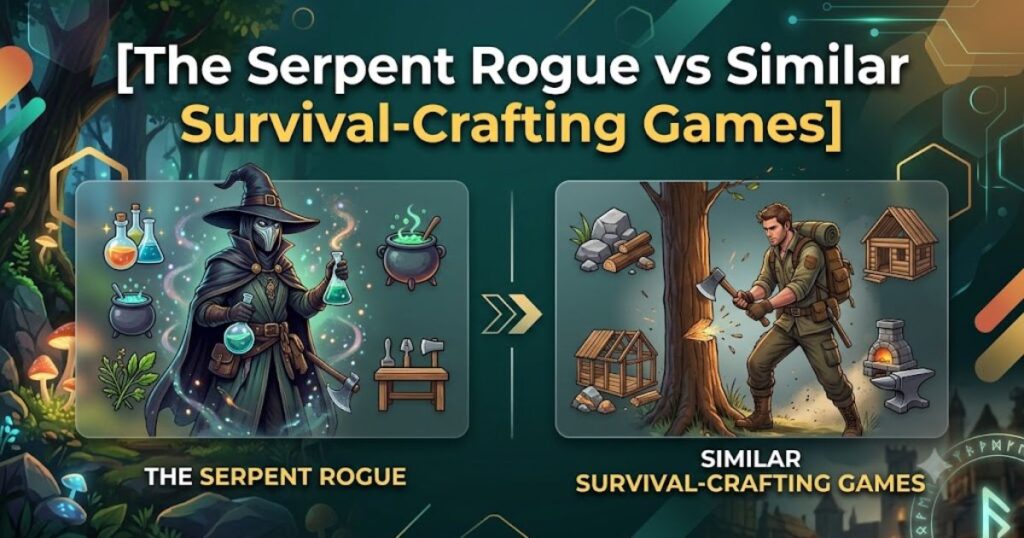
If you’re deciding whether The Serpent Rogue fits your taste, here’s how it compares to a few similar titles.
| Feature | The Serpent Rogue | Typical Survival Crafting Game | Typical Roguelike |
|---|---|---|---|
| Core focus | Alchemy and exploration | Base building, resource gathering | Combat and run progression |
| Combat depth | Light, tool-dependent | Varies, often secondary | Central to gameplay |
| Time pressure | Corruption storms per zone | Usually minimal | Run-based, restarts on death |
| Companions | Animal and human allies | Sometimes present | Rare |
| Best for | Players who enjoy puzzles and crafting over action | Players who enjoy long-term building | Players who enjoy fast, repeatable challenge |
This comparison isn’t about which game is “better.” It’s about matching expectations, since players expecting a combat-heavy roguelike sometimes feel let down, while players expecting a crafting-first experience tend to enjoy it more.
Pros and Cons
Pros
- Deep, satisfying alchemy system with real strategic value
- Unique art style that feels fresh compared to typical fantasy RPGs
- Companion system adds variety to exploration
- Rewards planning and patience over reflexes
Cons
- Combat can feel clunky, especially early on
- Durability system is punishing and can frustrate new players
- Some design choices, like limited weapon interactions, feel restrictive
- Pacing can feel slow if you’re expecting action-heavy gameplay
Reviewers have had mixed reactions to the game. Some outlets praised the concept and visual style but felt the execution was uneven, describing certain combat decisions as frustrating for an otherwise promising game. It’s worth going in with realistic expectations rather than assuming it plays like a typical action RPG.
Expert Tips From Experienced Players
- Travel light. The weight system punishes overpacking, so drop non-essential items at your storage chest before a run.
- Research before you explore deeper. Knowing what an ingredient does before you need it saves time later.
- Don’t fight everything. Retreating is often the smarter, more efficient choice.
- Rotate potions instead of memorizing recipes blindly. Understanding why a recipe works matters more than memorizing it.
- Use storms strategically. A reset zone can refill rare ingredients like Mandragore.
Common Mistakes That Cost Players Their Edge
- Rushing into corrupted zones without checking supplies first
- Fighting every enemy instead of avoiding avoidable fights
- Ignoring the corruption timer until it’s almost too late
- Hoarding ingredients without researching them
- Forgetting to manage companion needs like food and rest
Most of these mistakes come from treating The Serpent Rogue like a fast-paced action game. Slowing down fixes almost all of them.
FAQs About Serpent Rogue
What is the best way to get a competitive edge in The Serpent Rogue?
The best way to get a competitive edge in The Serpent Rogue is to focus on alchemy and corruption management first. Strong potion crafting and smart timing matter more than combat skill.
Is alchemy really that important in The Serpent Rogue?
Alchemy affects healing, transformation, survival, and combat support, making it one of the most important systems in the entire game.
How do I get companions in The Serpent Rogue?
You can get animal companions by completing a quest for Mavka. Human companions unlock later, once you’ve opened up the Pier area.
What causes a corruption storm?
Corruption storms happen on a timer within each corrupted zone. They sweep through the area and can be dangerous or deadly if you’re still there when it hits.
Should beginners avoid combat in The Serpent Rogue?
Not entirely, but beginners should avoid unnecessary fights. Combat has a punishing durability system, so it’s usually smarter to fight only when needed.
Where can I find Mandragore?
Mandragore appears in small amounts in the Wasteland, usually in the southwest area with visible red leaves. Resting through a corruption storm can reset the zone for more.
What platforms is The Serpent Rogue available on?
The Serpent Rogue is available on Windows PC, PlayStation 5, Xbox Series X/S, and Nintendo Switch.
Who developed The Serpent Rogue?
The Serpent Rogue was developed by Sengi Games, a Ukrainian studio, and published by Team17.
Is The Serpent Rogue more combat-focused or crafting-focused?
It’s primarily crafting and exploration-focused. Combat exists but plays a supporting role rather than the main challenge.
Can I carry a Portable Lab with me?
Though it’s heavy. A Portable Lab lets you research and brew potions away from your base, and it can be crafted at the Smeltery.
Does attacking an enemy while they’re healing help or hurt me?
It can actually help the enemy. If you attack while they’re using a healing item, that healing can end up benefiting them instead of going to waste.
Is The Serpent Rogue worth playing in 2026?
For players who enjoy alchemy-based crafting and slower, puzzle-like exploration, yes. If you’re looking for fast action combat, it may feel slower than expected.
Conclusion
A real Serpent Rogue competitive edge doesn’t come from one trick or shortcut. It comes from understanding how alchemy, taming, combat, and corruption timers work together. Once you stop panicking through runs and start planning them, the game becomes noticeably easier to manage.
Focus on researching ingredients early, build a reliable potion rotation, avoid unnecessary fights, and respect the corruption timer. Do that consistently, and every run gets a little cleaner than the last.
Rameen Zara is the founder of Clarity Nooks, bringing over five years of experience in home décor and interior styling. She shares simple yet practical design ideas that suit real homes and everyday living. Her approach focuses on cozy aesthetics, soft color palettes, and natural textures that create warm, inviting spaces.