

Money BetterThisWorld: A Practical Guide to Smarter, Purposeful Finances

Money BetterThisWorld is a money mindset that treats every dollar as a tool, not a trophy. It combines basic financial habits budgeting, saving, and investing with a simple question: does this purchase move my life forward? This guide breaks the idea into steps you can actually use, whether you’re just starting out or already managing a full budget.
If you’ve searched for “Money BetterThisWorld,” you’ve probably noticed it isn’t a bank, an app, or a registered company. It’s a concept that several personal-finance blogs use to describe intentional money management. This article treats it that way as a mindset and a set of habits and backs every claim with standard, well-established financial guidance, not hype.
What Does Money BetterThisWorld Mean?
Money BetterThisWorld means managing your money with intention instead of habit. Instead of spending on autopilot, you check each financial decision against your actual goals stability, freedom, or a specific life plan.
This isn’t about extreme frugality. You can still travel, buy things you enjoy, or eat out. The difference is that these choices happen inside a plan, not instead of one. Financial expert consensus from certified financial planners to government resources like the Consumer Financial Protection Bureau agrees on the same basics: track your spending, build savings, avoid high-interest debt, and invest for the long term. Money BetterThisWorld is simply a friendlier name for that same, proven approach.
Why a Money Mindset Matters More Than Income

Your mindset about money often matters more than how much you earn. Many people with solid incomes still live paycheck to paycheck because of unplanned spending, emotional purchases, or no clear savings goal. Meanwhile, people with modest incomes can build real security through consistent habits.
Common limiting beliefs include:
- “I’m just not good with money.”
- “Saving won’t make a real difference.”
- “I’ll start budgeting once I earn more.”
These beliefs usually aren’t true, but they shape behavior. A useful first step is naming the belief, writing it down, and testing it with a small action like saving $10 this week to prove you can.
Must Read This Post: Connections Hint Mashable: Your Complete Guide to Daily Puzzle Help
The Core Pillars of Money BetterThisWorld
Money BetterThisWorld rests on five pillars that show up in almost every reputable financial plan:
- Budgeting – knowing where your money goes each month
- Saving – building a cushion for emergencies and goals
- Debt management – paying down high-interest debt strategically
- Investing – growing wealth over time through consistent contributions
- Purpose-based spending – aligning purchases with your actual values and goals
None of these pillars work well in isolation. A budget without savings goals is just bookkeeping. Investing without an emergency fund is risky. The pillars work together.
Step-by-Step: How to Apply Money BetterThisWorld
Here’s a simple sequence to follow, especially if you’re a beginner:
- Track your spending for 30 days. Use a notebook, spreadsheet, or a budgeting app. You can’t manage what you don’t measure.
- Build a bare-bones budget. List fixed costs (rent, utilities, insurance) and variable costs (food, transport, entertainment).
- Set one small savings goal. Start with something achievable, like $500 for emergencies.
- Automate what you can. Set up automatic transfers to savings right after payday, before you can spend the money.
- Tackle high-interest debt. Prioritize anything above 7–8% interest, such as most credit cards.
- Start investing, even small amounts. Many retirement and brokerage accounts allow contributions as low as $25–$50 a month.
- Review monthly. Adjust your budget and goals as your income or life circumstances change.
Don’t Miss This Post: The Serpent Rogue Competitive Edge: A Complete Strategy Guide
Budgeting the BetterThisWorld Way
The fastest way to start budgeting is the 50/30/20 rule: 50% of income to needs, 30% to wants, and 20% to savings and debt repayment. It’s not a perfect fit for everyone, but it’s a solid starting point recommended by many financial educators, including in Senator Elizabeth Warren’s original book on the topic.
A few practical tips:
- Use separate accounts for bills, spending, and savings so money doesn’t blend together.
- Review subscriptions every three months unused ones quietly drain budgets.
- Build a small “fun money” line item. Budgets that allow zero enjoyment rarely last.
Money BetterThisWorld and the 24-Hour Rule
One habit that fits naturally into a Money BetterThisWorld approach is the 24-hour rule: wait a day before any non-essential purchase over a set amount, like $75. This single pause reduces impulse spending significantly, because most impulse urges fade within hours.
Saving and Emergency Funds
An emergency fund is money set aside only for real emergencies job loss, medical bills, or urgent repairs. Most financial planners recommend three to six months of essential expenses, though the right number depends on job stability, dependents, and existing insurance coverage.
If saving that much feels overwhelming, start smaller:
- Save one month of expenses first.
- Then build toward three months.
- Then aim for six, especially if your income is variable or you’re self-employed.
High-yield savings accounts, which are FDIC-insured up to $250,000 per depositor per bank, are a reasonable place to keep this money it stays accessible and earns some interest, unlike a low-rate checking account.
Also Read This Post: 5StarsStocks com: Review 2026 Is This AI Stock Picker Worth Trusting
Debt: What to Pay Off First
High-interest debt is usually the biggest obstacle to building wealth. As a general guideline, treat any debt above 7–8% interest most credit cards and many personal loans as a priority.
Two common strategies:
- Debt avalanche: Pay off the highest-interest debt first. This saves the most money in interest over time.
- Debt snowball: Pay off the smallest balance first. This builds momentum and motivation, even if it costs slightly more in interest.
Neither method is objectively “correct.” The avalanche method is more efficient mathematically; the snowball method often works better for people who need visible progress to stay motivated.
Investing With Purpose
Investing turns saved money into growing money. The earlier you start, the more time compound growth has to work though markets can and do go up and down, and past performance never guarantees future results.
A few widely accepted starting points:
- Employer retirement plans (like a 401(k)) especially valuable if there’s an employer match, since that’s essentially free money.
- Individual Retirement Accounts (IRAs) useful if you don’t have a workplace plan, or want additional tax-advantaged savings.
- Low-cost index funds these spread your money across many companies, reducing the risk of any single company’s poor performance.
Diversification spreading investments across sectors and asset types is one of the most effective ways to manage risk, since weak performance in one area can be offset by stronger performance elsewhere.
This article is for general education only and isn’t personalized financial advice. For decisions specific to your situation, a licensed financial advisor or tax professional can help.
Comparison: Traditional Budgeting vs. Money BetterThisWorld
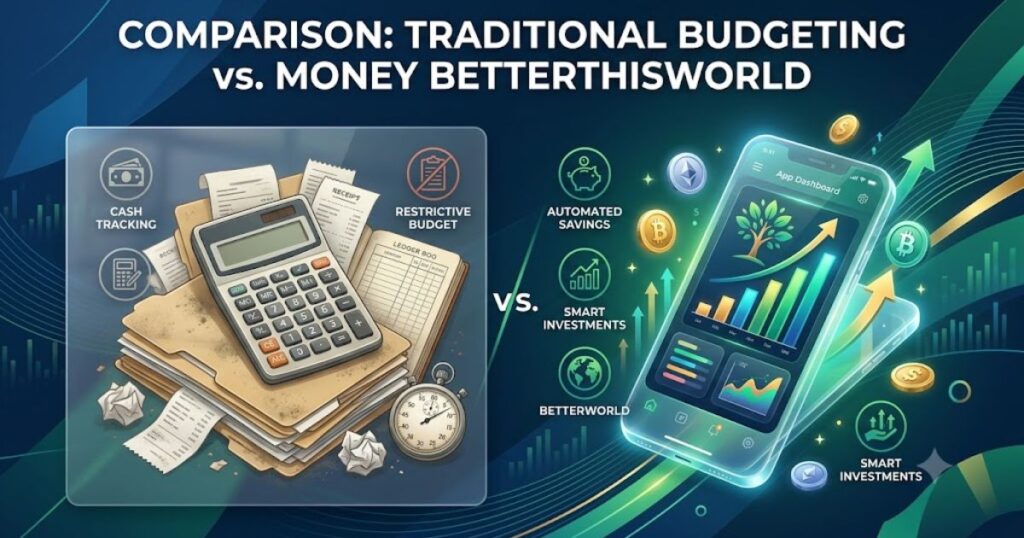
| Feature | Traditional Budgeting | Money BetterThisWorld Approach |
|---|---|---|
| Main focus | Tracking numbers | Tracking numbers + personal values |
| Spending decisions | Based on category limits | Based on limits + purpose check |
| Motivation | Discipline | Discipline + meaning |
| Flexibility | Often rigid | Built around long-term goals, adaptable |
| Best for | People who like structure | People who want structure with intention |
Both approaches use the same core financial tools. The difference is mainly in mindset and framing, not in the underlying math.
Pros and Cons
Pros:
- Encourages intentional, less impulsive spending
- Combines practical steps with a clear “why”
- Works for any income level
- Easy to start with small, low-risk actions
Cons:
- It’s a mindset framework, not a regulated financial product or guaranteed strategy
- Results depend entirely on consistency and personal discipline
- Doesn’t replace professional financial or tax advice for complex situations
Common Money Mistakes to Avoid
- No emergency fund. Without one, a single unexpected bill can lead to high-interest debt.
- Lifestyle inflation. Increasing spending every time income rises, leaving savings flat.
- Ignoring high-interest debt. Letting credit card balances grow while trying to invest elsewhere usually costs more than it earns.
- All-or-nothing budgeting. Abandoning a budget entirely after one bad month, instead of adjusting it.
- Waiting to start investing. Delaying investing until you “have enough” often means losing years of potential growth.
Expert Tips
- Automate first, decide later. Automatic transfers remove the daily willpower requirement.
- Name your savings goals. An account labeled “New Car Fund” gets protected more often than one labeled “Savings 2.”
- Review, don’t obsess. A monthly 15-minute check-in beats daily anxious tracking.
- Match debt payoff to interest rate, not balance size, if your goal is minimizing total cost.
- Increase savings rate with raises, not just spending, to avoid lifestyle inflation.
FAQs About Money BetterThisWorld
What is Money BetterThisWorld?
Money BetterThisWorld is a money-management mindset that combines practical financial habits budgeting, saving, debt management, and investing with intentional, values-based spending.
Is Money BetterThisWorld a company or app?
It’s a financial concept and mindset used across several blogs and guides, not a registered financial institution or product.
Is Money BetterThisWorld good for beginners?
Beginners can start with basic steps like tracking expenses, creating a simple budget, and saving a small emergency fund before moving to investing.
How do I start applying Money BetterThisWorld today?
Start by tracking your spending for 30 days, then build a basic budget, automate savings, and set one specific, measurable financial goal.
Should I save or pay off debt first?
It depends on your situation. Many experts recommend building a small starter emergency fund first, then aggressively paying off high-interest debt (above 7–8%), then building a full emergency fund and investing.
How much should I keep in an emergency fund?
A common target is three to six months of essential expenses, adjusted for your income stability, dependents, and insurance coverage.
Does Money BetterThisWorld mean I can’t spend on things I enjoy?
It focuses on moderation and intention, not deprivation. Enjoyable spending is fine when it fits inside your plan and goals.
What’s the difference between the debt avalanche and debt snowball methods?
The avalanche method pays off the highest-interest debt first to save the most money. The snowball method pays off the smallest balance first to build motivation.
Can Money BetterThisWorld help with investing, not just saving?
It encourages starting to invest early and consistently, often through retirement accounts or low-cost index funds, while managing risk through diversification.
Is there a guaranteed result from following Money BetterThisWorld principles?
Like any financial strategy, results depend on consistency, income, market conditions, and personal circumstances. There are no guarantees in personal finance.
Do I need a financial advisor to start?
Not necessarily for basic budgeting and saving. For complex situations taxes, investments, retirement planning a licensed financial advisor is recommended.
How is Money BetterThisWorld different from just “budgeting”?
Budgeting is one part of it. Money BetterThisWorld also emphasizes checking spending against personal values and long-term goals, not just staying inside category limits.
Conclusion
Money BetterThisWorld isn’t a secret system or a shortcut to wealth. It’s a straightforward reminder that money works best when it’s managed with a plan and a purpose. Track your spending, build savings, handle high-interest debt first, and invest consistently and let your goals, not your impulses, guide each decision. Small, steady habits, repeated over months and years, are what actually build financial security.
Ready to put this into action? Start today: track every dollar you spend for the next seven days, then use that information to build your first simple budget.
Rameen Zara is the founder of Clarity Nooks, bringing over five years of experience in home décor and interior styling. She shares simple yet practical design ideas that suit real homes and everyday living. Her approach focuses on cozy aesthetics, soft color palettes, and natural textures that create warm, inviting spaces.