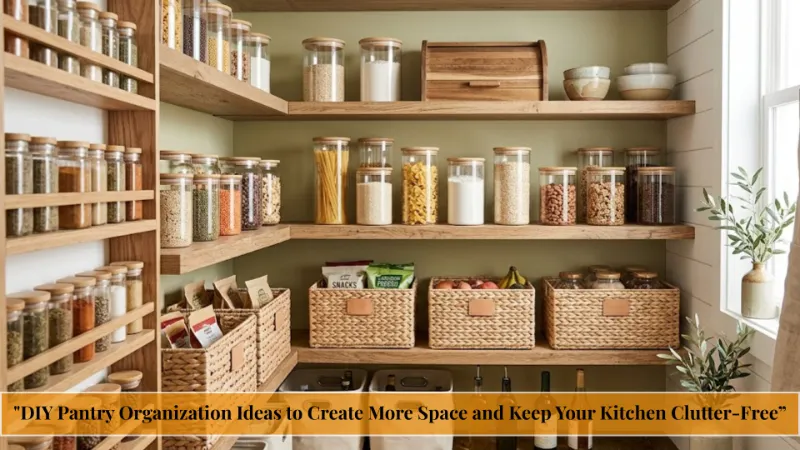
DIY Pantry Organization Ideas to Create More Space and Keep Your Kitchen Clutter-Free

Is your pantry a chaotic jumble of mismatched containers, forgotten cans, and half-eaten snacks? You’re not alone. Cluttered pantry storage is one of the most common frustrations in modern homes and it costs you time, money, and mental energy every single day. Studies show that the average American household wastes over $1,500 worth of food annually simply because items get lost or forgotten in disorganized spaces. The good news? You don’t need to spend a fortune or hire a professional organizer to fix it.
In this guide, you’ll discover practical, creative, and budget-friendly DIY pantry organization ideas that actually work in real kitchens from tiny apartment pantries to sprawling walk-in spaces. Each idea comes with step-by-step instructions, materials, estimated costs, and decorating tips so you can transform your kitchen storage this weekend without breaking the bank.
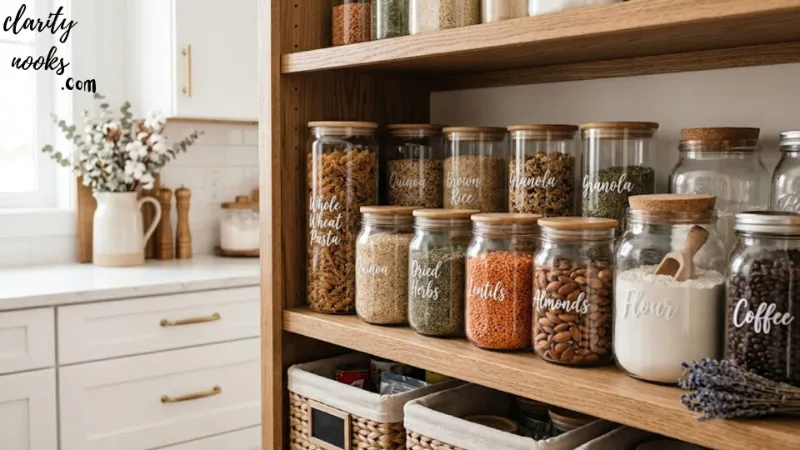
Whether you’re a renter who can’t drill holes or a homeowner ready for a full pantry overhaul, these DIY pantry ideas are scalable, stylish, and sustainable. Let’s dive in.
🔍 Featured Snippet:
What is the best way to organize a pantry? The best way to organize a pantry is to first empty it completely, then group items by category (grains, canned goods, snacks, baking supplies), use uniform containers with clear labels, maximize vertical space with shelf risers, and place frequently used items at eye level. Consistent labeling and zone-based organization are the keys to a pantry that stays tidy long-term.
Use Clear Airtight Containers for Dry Goods
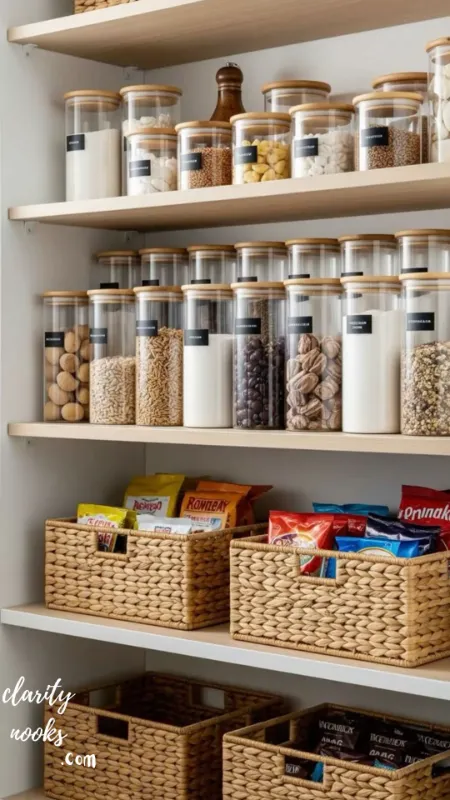
One of the single most impactful pantry organization ideas is switching from original packaging to clear, airtight storage containers. When you can see exactly what you have flour, pasta, rice, cereal you stop overbuying and wasting. It’s a visual inventory system that works passively every day.
For best results, choose containers from a single set so they stack neatly. OXO Good Grips, IKEA 365+, and budget-friendly options from Amazon all work well. Use a label maker or chalkboard labels to identify contents and expiry dates. Group them by category baking, grains, snacks and arrange with the tallest containers at the back.
| Materials Needed | Airtight containers (varied sizes), label maker or chalk labels, a funnel |
| Estimated Cost | $20–$80 depending on set size and brand |
| Time Required | 2–3 hours for a standard pantry |
| Key Benefit | Reduces food waste, improves visibility, keeps food fresh longer |
| Decorating Tip | Stick to one container style and matching labels for a cohesive, magazine-worthy look |
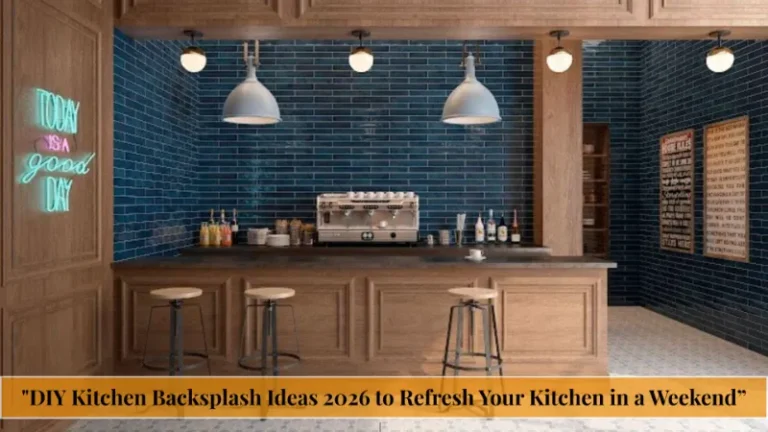
Learn more here: DIY Kitchen Backsplash Ideas 2026 to Refresh Your Kitchen in a Weekend
Install Shelf Risers to Double Your Vertical Space
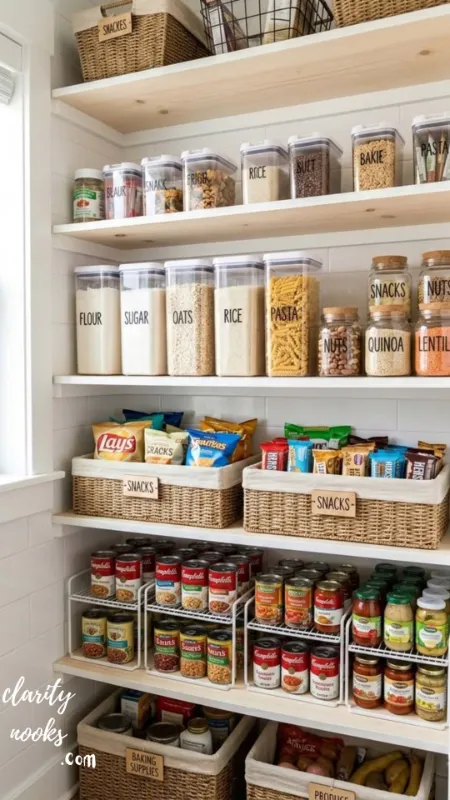
Most pantry shelves have far more vertical space than we use. A shelf riser or can organizer instantly creates a second tier within the same shelf, essentially doubling your usable storage. This is especially powerful for canned goods organization, where you can stagger cans so every label faces forward and nothing gets buried.
You can buy expandable wire shelf risers at any home goods store, or build your own with scrap wood cut to size. Paint them in a neutral color to blend with your shelves. For a more polished look, use tiered bamboo organizers they’re affordable, eco-friendly, and add warmth to your pantry aesthetic.
| Materials Needed | Wire or wood shelf risers, optional paint or stain |
| Estimated Cost | $10–$30 per shelf |
| Time Required | 30 minutes per shelf |
| Key Benefit | Maximizes vertical space, improves can visibility |
| Decorating Tip | Use matching risers throughout for a clean, uniform appearance |
See the full breakdown: DIY Kitchen Lighting Ideas to Make Your Kitchen Look Modern and Warm
Add a Lazy Susan for Corner or Deep-Shelf Access
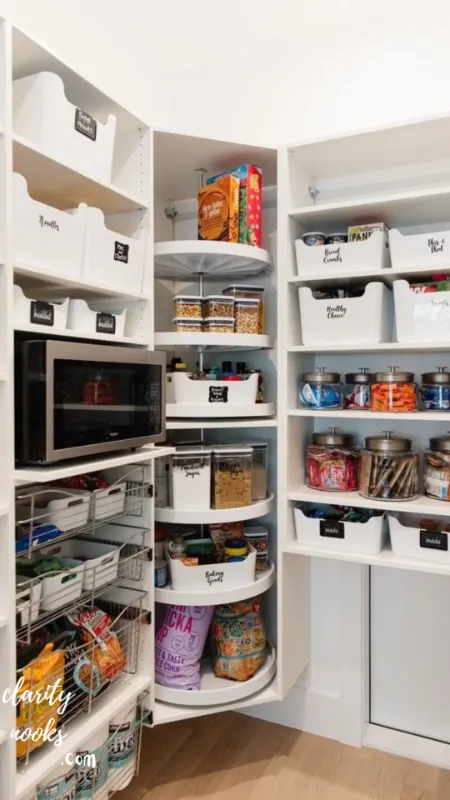
Corner pantries and deep shelves are notorious space-wasters because items at the back become invisible. A lazy Susan turntable is the ultimate fix spin it to reach oils, vinegars, sauces, or spices with a single finger. It’s one of those DIY kitchen organization tricks that feels almost too simple for how effective it is.
Use a single large lazy Susan for a deep shelf, or stack two-tier turntables for spices and small jars. Real-life scenario: Sarah, a mother of three in Ohio, had a pantry where the back corners collected expired sauces and mystery spice jars. After adding two lazy Susans, she found and used ingredients she’d forgotten for over a year saving her an estimated $40 in duplicate purchases that month alone.
| Materials Needed | Lazy Susan turntable (6″, 9″, 12″ sizes available) |
| Estimated Cost | $8–$25 per turntable |
| Time Required | 5 minutes to set up |
| Key Benefit | Eliminates dead corner space, reduces forgotten items |
| Decorating Tip | Match turntable color to container lids for a cohesive look |
Read our expert tips: Creative DIY Kitchen Nook Ideas That Make Your Kitchen Feel Warm and Inviting
Create a Dedicated Snack Station with Bins and Baskets
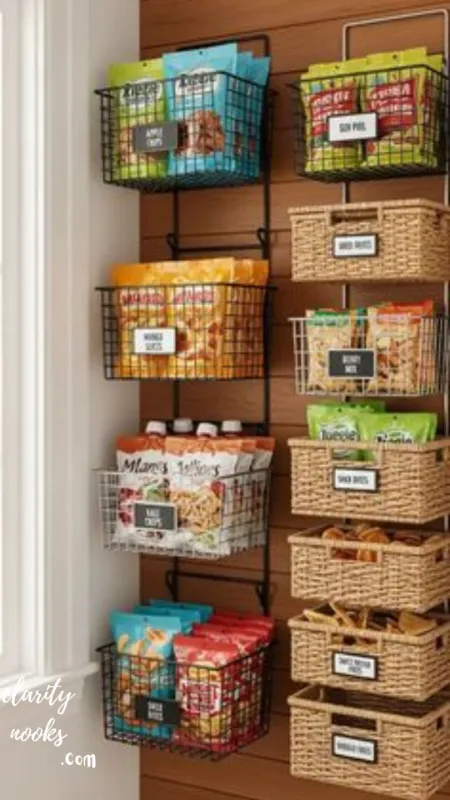
Randomly scattered snacks are a pantry’s arch-enemy. A dedicated snack zone using labeled bins or baskets transforms chaos into order and it’s especially useful for families with kids. Place this zone at a lower shelf so children can independently grab snacks without pulling everything off shelves above.
Use wire bins, fabric baskets, or wicker baskets to group snacks by type: chips, granola bars, fruit snacks, crackers. Label each bin clearly. This system is also great for pantry zone organization the principle of dedicating specific shelf space to specific food categories. When everything has a home, it naturally goes back where it belongs.
| Materials Needed | Wire or wicker bins/baskets, labels, optional shelf liner |
| Estimated Cost | $15–$50 depending on basket type and quantity |
| Time Required | 1–2 hours |
| Key Benefit | Reduces clutter, easy for kids to navigate, maintains order |
| Decorating Tip | Use matching baskets in a neutral tone seagrass and white wire are trending |
View the complete tutorial: DIY Small Kitchen Ideas to Make Cooking Spaces More Functional
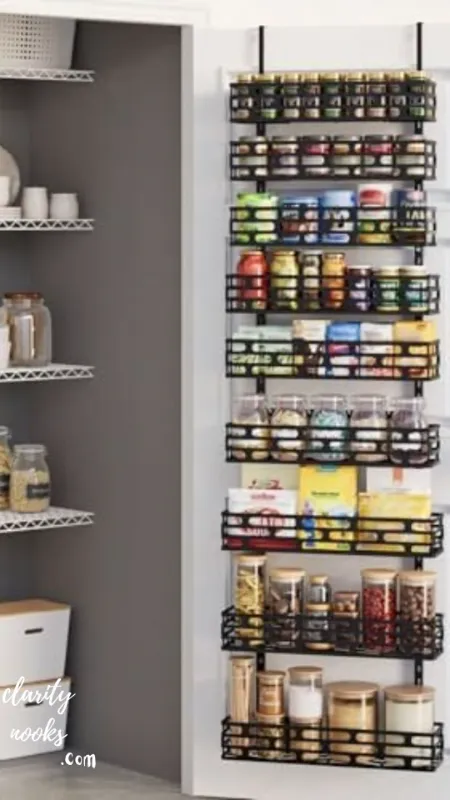
Mount a Door-Mounted Organizer to Unlock Hidden Space
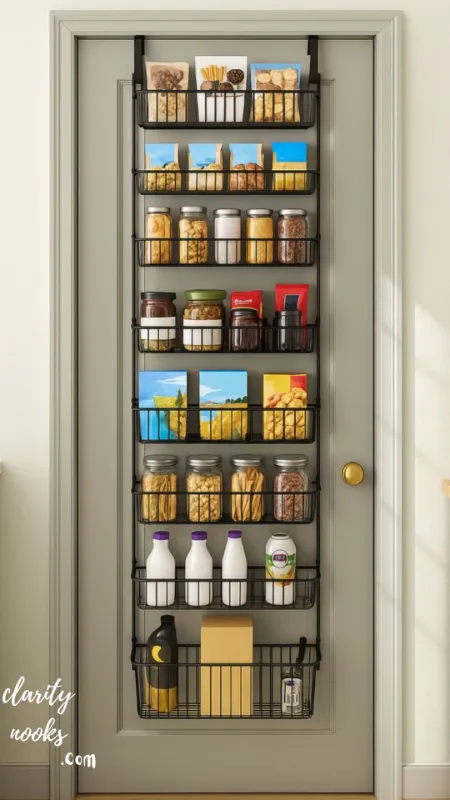
Your pantry door is prime real estate you’re probably ignoring. A door-mounted organizer whether an over-the-door rack, a pegboard panel, or a shoe organizer repurposed for spices adds significant storage without taking up any shelf space. This is a game-changer for small pantry organization where every square inch counts.
For a DIY approach, mount a pegboard sheet (available at any hardware store) to the back of your pantry door using spacers. Add hooks, small shelves, and bins for spices, foil, and plastic wrap. No drilling required if you use over-door hooks and tension rods making it renter-friendly and damage-free.
| Materials Needed | Over-door rack or pegboard + hooks, or clear shoe organizer |
| Estimated Cost | $10–$40 |
| Time Required | 1 hour |
| Key Benefit | Utilizes dead door space, keeps frequently used items accessible |
| Decorating Tip | Paint pegboard white or a soft color to make labels pop |
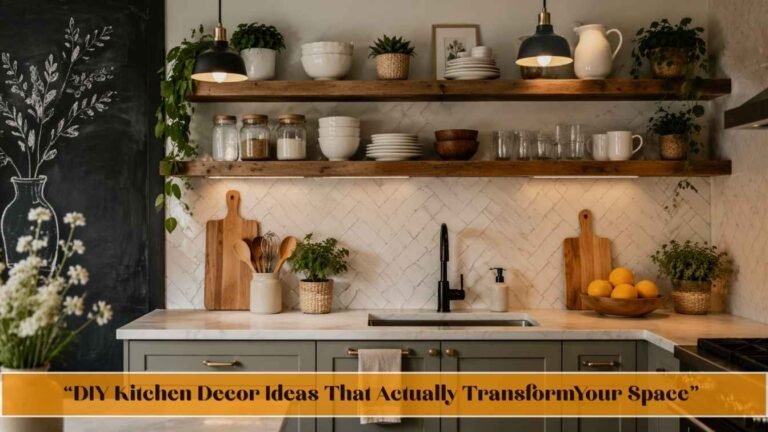
Don’t miss this guide: DIY Kitchen Decor Ideas That Actually Transform Your Space
Build a DIY Pull-Out Drawer for Lower Shelf Access
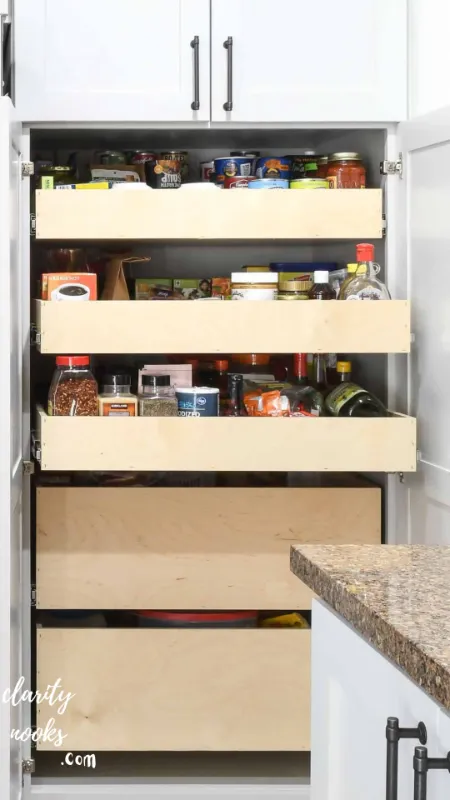
Lower pantry shelves are often underused because bending to find items at the back is inconvenient. A simple pull-out drawer insert made from a wooden crate, a drawer glide kit, and some basic tools transforms an awkward shelf into a fully accessible storage space. This is one of the most satisfying DIY pantry shelf ideas you’ll tackle.
Purchase wooden crates from a craft store or repurpose old ones. Sand, paint or stain them, then attach drawer slides to a piece of plywood as a base. Slide the crate onto the base and push it under the shelf. Now potatoes, onions, and heavy canned goods are all instantly reachable. Mini case study: Tom, a DIY enthusiast from Texas, built three pull-out crates for under $35 total far cheaper than the $200+ cabinet inserts he’d been considering.
| Materials Needed | Wooden crates, drawer slide kit, sandpaper, paint, screws |
| Estimated Cost | $12–$35 per drawer |
| Time Required | 3–4 hours (including drying time) |
| Key Benefit | Makes deep lower shelves fully functional |
| Decorating Tip | Stain in walnut or paint white/sage for a boutique kitchen feel |
See our latest insights: DIY Front Door Decor Ideas: 9 Creative Ways to Transform Your Entryway on a Budget
Create a Spice Drawer with a Labeled Insert
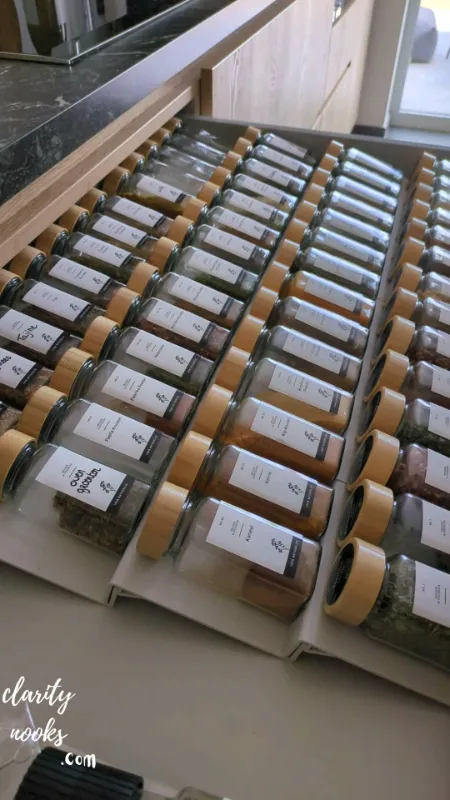
A dedicated spice drawer is arguably the highest-ROI pantry project you can tackle. When spices are stored horizontally in a drawer with angled labels facing up, you can find any spice in seconds rather than hunting through a cluttered cabinet. This spice organization system also stops duplicate purchases a costly habit most cooks don’t notice.
Use a bamboo spice drawer insert or cut foam to fit your drawer to hold bottles in angled rows. Decant spices into uniform small jars (4 oz mason jars are perfect) and label the lids. Alphabetical order or category grouping (baking spices, savory blends, heat) both work well depending on how you cook.
| Materials Needed | Bamboo insert or cut foam, uniform spice jars (or 4 oz mason jars), labels |
| Estimated Cost | $20–$50 |
| Time Required | 2–3 hours |
| Key Benefit | Instant spice visibility, no duplicates, faster meal prep |
| Decorating Tip | Match jar lids (gold or black) to your kitchen hardware for a high-end look |
Visit our knowledge hub: DIY Garden Lighting Ideas to Create a Magical Outdoor Space on a Budget
Use Tension Rods as Vertical Dividers
Tension rods aren’t just for curtains they’re one of the most underrated pantry organizing tools available. Placed vertically between shelves, they create individual slots for baking sheets, cutting boards, pot lids, and trays that would otherwise form a chaotic pile you have to dig through every time you cook.
Simply expand the tension rod to fit snugly between shelves with no tools or damage required. Space multiple rods to create the slot widths you need. This is a brilliant renter-friendly pantry organization hack that costs less than $5 per rod. It also works well inside deep drawers as a divider system for foil rolls, plastic wrap, and parchment paper.
| Materials Needed | Tension rods (adjustable spring-loaded rods) |
| Estimated Cost | $3–$8 per rod |
| Time Required | 5 minutes |
| Key Benefit | Stops baking sheets from sliding everywhere, renter-safe, no tools needed |
| Decorating Tip | Choose matte black or brushed nickel rods to complement your pantry hardware |
Label Everything with a Consistent Labeling System
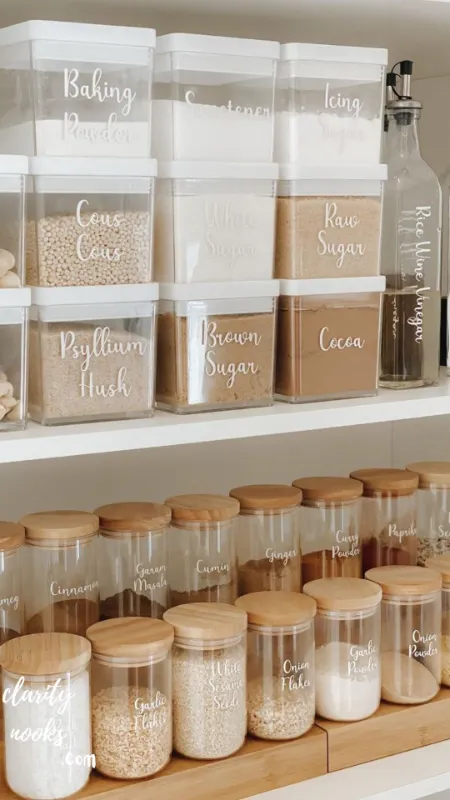
Labeling is the invisible foundation that holds every pantry organization system together. Without labels, even the most beautifully organized pantry will gradually descend back into chaos. Labels tell every member of the household exactly where things go eliminating the “where does this belong?” paralysis that derails even the best-intentioned organizers.
The most popular labeling methods in 2026-2027 include P-Touch label makers, chalkboard labels (rewritable for seasonal items), and printed waterproof vinyl labels. Pick one font and one color scheme throughout your entire pantry. Label containers, bins, baskets, shelves, and even shelf edges. Consistent labeling is the difference between a pantry that stays organized for three weeks versus three years.
| Materials Needed | Label maker, chalkboard stickers, or printed vinyl labels |
| Estimated Cost | $10–$40 (label maker) or $5–$15 (sticker sheets) |
| Time Required | 1–2 hours for a full pantry |
| Key Benefit | Maintains long-term organization, helps all family members |
| Decorating Tip | Use a single elegant font Futura or Raleway-style for a professional finish |
Install Floating Shelves for Open Pantry Areas
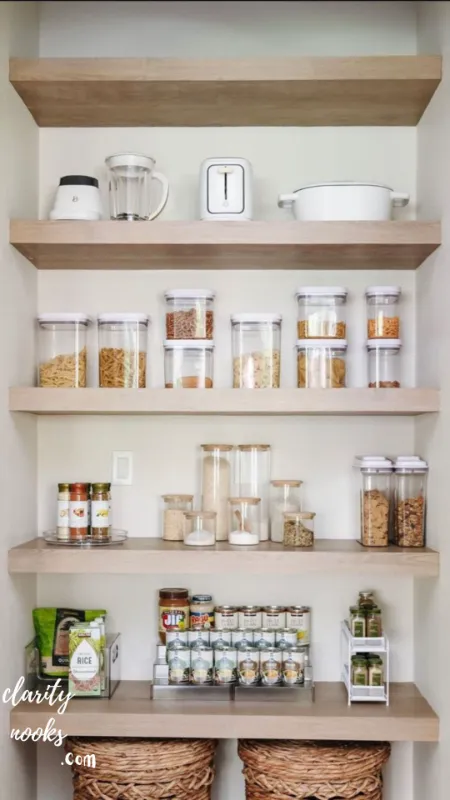
If you have a wall area near your kitchen that isn’t being used, floating shelves can create an open pantry concept that’s both functional and visually stunning. This is ideal for frequently used items oils, vinegars, cookbooks, decorative jars that deserve to be on display. Open pantry shelving is one of the top kitchen trends driving DIY projects in 2025 and 2026.
Install wooden floating shelf brackets using a level and wall anchors. Pine boards from any hardware store can be stained or painted to match your kitchen. Keep the styling intentional don’t overcrowd. Use groupings of three (a principle from interior design) with a tall item, a medium item, and a small item at varying heights for an organic, curated look.
| Materials Needed | Pine board, floating shelf brackets, wall anchors, wood stain or paint |
| Estimated Cost | $20–$60 per shelf |
| Time Required | 2–3 hours per shelf |
| Key Benefit | Creates visual storage, makes kitchen feel larger, displays beautiful items |
| Decorating Tip | Style with wicker baskets, glass jars, and small plants for a warm aesthetic |
Repurpose Magazine Holders for Foil, Bags, and Flat Items
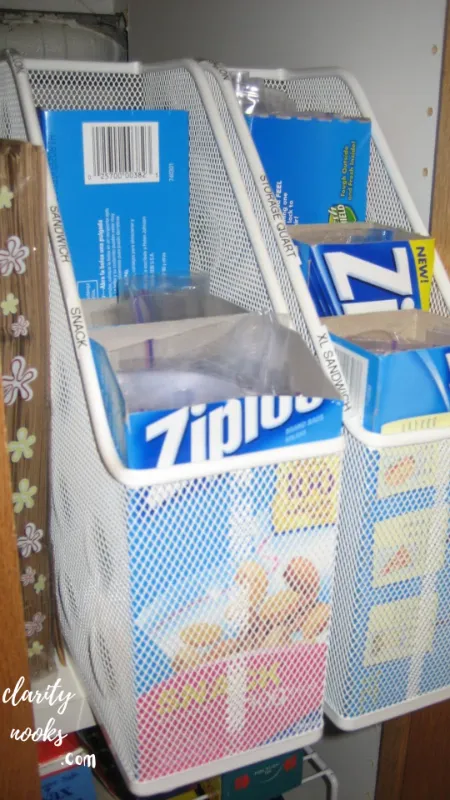
Aluminum foil boxes, zip-lock bag boxes, and parchment paper rolls are notoriously difficult to store neatly they fall over, take up awkward shelf real estate, and slide around constantly. The solution? Repurposed magazine holders or vertical file organizers. Mount them on the side of a shelf or pantry wall to hold these items upright and accessible.
Acrylic or metal magazine holders cost under $2 each and can be mounted with small Command strips for a damage-free pantry organization solution. Label each one for its specific item. This same technique works brilliantly for cutting boards, baking mats, and even small pot lids. It’s one of those cheap pantry organization ideas that looks like it came from a professional organizer.
| Materials Needed | Magazine holders (metal, acrylic, or wire), Command strips or screws |
| Estimated Cost | $2–$8 per holder |
| Time Required | 20 minutes |
| Key Benefit | Neatly stores awkward flat/roll items, frees up shelf space |
| Decorating Tip | Choose matte white or clear acrylic for a clean, modern look |
Create a First-In, First-Out (FIFO) Canned Goods System
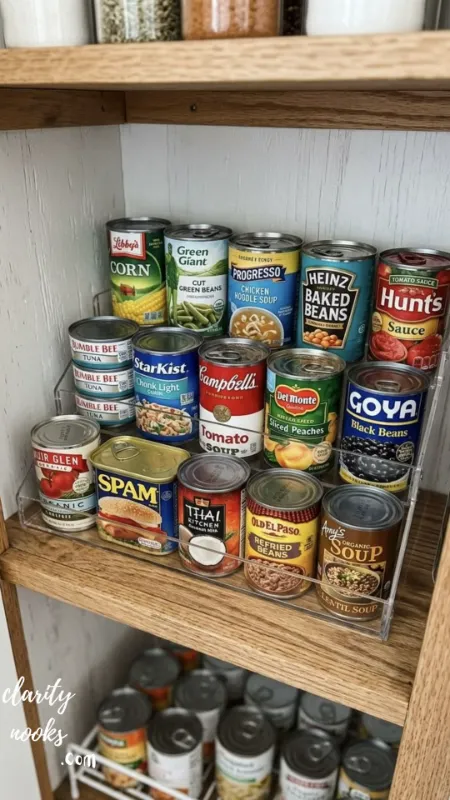
The FIFO (First-In, First-Out) method is how commercial kitchens and grocery stores prevent food waste and you can apply the same system to your home pantry. New cans go behind older ones, so you always use the oldest items first. This dramatically reduces the problem of discovering expired cans buried in the back of a shelf.
You can DIY a can dispenser organizer using cardboard or thin plywood build an inclined tray where cans roll from the back to the front automatically. Alternatively, buy an affordable can organizer rack from Amazon for $15–$30 that does the same thing without DIY effort. Either way, pair it with labels indicating the category of each row for maximum efficiency.
| Materials Needed | Cardboard/plywood for DIY, or a pre-made can organizer rack |
| Estimated Cost | $0–$5 DIY | $15–$30 purchased |
| Time Required | 1–3 hours DIY | 10 minutes if pre-made |
| Key Benefit | Eliminates food waste, ensures you always use oldest items first |
| Decorating Tip | Label each row by food type for an orderly, professional look |
Real-Life Pantry Transformation: The Martinez Family
📋 Mini Case Study:
The Martinez family two working parents and four kids in a 1,200 sq ft apartment in Chicago had a 3-shelf pantry that was in a constant state of chaos. They couldn’t find anything, regularly bought duplicate spices, and threw out roughly $80 in expired food every month.
Their DIY transformation cost just $127 total: $45 on clear containers, $22 on baskets, $18 on a lazy Susan, $12 on a label maker, $15 on shelf risers, and $15 on a door organizer. The result? In the first month, they reported saving $60 in food waste and $25 in duplicate grocery purchases.
The pantry now takes 15 minutes to maintain weekly instead of the hour-long decluttering sessions they used to do monthly. Key lesson: You don’t need a walk-in pantry or a large budget. Consistent zones, uniform containers, and clear labels make any pantry work efficiently.
Conclusion
Transforming your pantry doesn’t require a renovation or a professional organizer. These DIY pantry organization ideas prove that a little creativity, a modest budget, and a thoughtful approach to kitchen storage can completely change how your home functions. From clear containers and lazy Susans to pull-out drawers and FIFO can systems, every idea here is proven, practical, and built for real life.
The best time to start? This weekend. Pick just two or three ideas from this guide, gather your materials, and commit a few hours to the project. You’ll gain not just a better-looking pantry, but genuine time savings, reduced food waste, and a calmer kitchen every single day. A well-organized pantry is one of the highest-ROI home improvements you can make and it’s entirely within your own two hands.
Trend Analysis: DIY Pantry Organization in 2026–2028
The home organization industry has grown into a multi-billion dollar market, and pantry organization specifically has seen explosive interest driven by the pandemic-era home cooking boom that never fully reversed. Google Trends data shows that searches for “pantry organization ideas” have sustained 200–300% higher search volumes compared to pre-2020 levels.
Key trends shaping the space through 2028 include the rise of sustainable organizing materials (bamboo, recycled plastic, glass over virgin plastic), the “calm pantry” aesthetic (neutral tones, no visual noise), and the integration of smart labels and QR code-linked inventory tracking. The open pantry concept displaying organized shelves as a design feature rather than hiding them continues to dominate interior design publications and social media platforms alike.
User behavior is also shifting toward “buy once, organize well” thinking investing in quality containers and systems once rather than repeatedly trying cheap fixes. For content creators and home bloggers, pantry organization content consistently outperforms other kitchen content in time-on-page and conversion metrics.
Practical Tips & Expert Insights
Professional organizers consistently recommend the “empty first” principle remove everything from your pantry before adding any organizational system. Organizing without a full empty-out typically results in hidden clutter that resurfaces within weeks. This step also forces a natural inventory audit that reveals expired items and forgotten duplicates.
A lesser-known insight: organize based on how you cook, not how it looks. An aesthetically driven pantry that doesn’t match your workflow will be abandoned within a month. If you bake every Sunday, your baking supplies should be the most accessible zone. If you meal-prep proteins, those ingredients should be front-and-center. Form must follow function in a functional kitchen pantry.
Also: designate an “overflow” zone for bulk purchases and items you rarely use. Keeping primary zones clean requires somewhere for the exceptions to live. A high shelf or a separate closet corner works perfectly for bulk paper goods, backup canned goods, and seasonal baking ingredients.
Long-Term Strategy & Sustainability
A truly successful pantry organization system isn’t a one-time project it’s a maintained habit. The key to long-term sustainability is building a system so intuitive that maintaining it requires almost no effort. This means designing zones that match natural usage patterns, using containers that are easy to open and refill, and having a weekly “10-minute reset” to return stray items to their zones.
From a sustainability standpoint, investing in glass containers over plastic is both environmentally and financially smarter long-term. Glass doesn’t absorb odors, stains, or chemicals it lasts decades compared to the 2–5 year lifespan of most plastic containers. Similarly, choosing bamboo organizers over plastic versions reduces environmental impact while actually looking more beautiful over time as the material develops a natural patina.
For scalability, design your system with future changes in mind. Will your household grow? Consider modular systems like stackable bins that can expand. Do you move frequently? Prioritize free-standing and door-mounted solutions over permanently installed ones. A flexible pantry organization strategy adapts to life changes without requiring a complete overhaul.
Future Predictions & Innovations in Pantry Organization
The intersection of smart home technology and kitchen organization is accelerating rapidly. By 2027, we expect to see widespread adoption of AI-powered pantry inventory systems cameras or RFID-enabled containers that automatically track what you have, what’s about to expire, and what you need to buy. Some early versions already exist as smart refrigerator features and will migrate to pantry contexts within 2–3 years.
Labels themselves are evolving. Smart QR code labels that link to recipe databases scan a jar of lentils to instantly pull up recipes using it are gaining traction in the premium home organization market. Meanwhile, e-ink display labels (similar to e-reader screens) that can be wirelessly updated from a smartphone are in development for home pantry use.
On the materials side, mycelium-based (mushroom-derived) packaging and bioplastic containers will become mainstream choices for eco-conscious organizers within the decade. The future of DIY pantry organization is simultaneously smarter, greener, and more beautiful than anything the market currently offers.
Common Mistakes & Hidden Gaps in Pantry Organization
Beginner Mistakes
- Organizing before purging: Putting organizational systems around expired or unwanted items is the most common mistake. Always empty and edit first.
- Buying containers without measuring: Beautiful containers that don’t fit your shelves or that are the wrong size for your quantities create new problems.
- Skipping labels: “I’ll remember where everything goes” is a myth in households with multiple people. Label everything, always.
- Aesthetic over function: Organizing for Instagram looks rather than personal workflow leads to systems that can’t be maintained.
Intermediate Mistakes (Gaps Competitors Miss)
- Ignoring the zone refresh cycle: Seasonal eating patterns change. What worked in summer (fresh herbs, BBQ sauces) needs repositioning in winter. Most people never re-optimize their zones.
- Using too many container sizes: Variety looks visually appealing but creates stacking and spacing problems. Stick to 3 sizes maximum.
- Forgetting to account for bulky packaging: Cereal boxes, large oat containers, and bulky items need dedicated space planning not afterthought shelf slots.
- Neglecting the pantry floor: The floor space inside a pantry can hold rolling carts, pet food bins, or large baskets a significantly underused zone in most homes.
- No maintenance routine: Even the best system fails without a scheduled weekly reset. Block 10 minutes every Sunday it’s the habit that makes organization permanent.
Frequently Asked Questions
How do I start organizing my pantry from scratch?
Start by emptying the pantry completely. Discard expired items, then group remaining items by category. Before buying any organizers, measure your shelves and assess what you actually have. Then introduce containers, labels, and zone systems based on how you cook.
What is the most budget-friendly pantry organization idea?
Tension rods as dividers and repurposed magazine holders are among the cheapest solutions both under $5 per unit. For containers, look for sets at dollar stores, IKEA, or during sales at Target and Walmart.
How do you organize a deep pantry shelf?
Use lazy Susans, pull-out drawer inserts, or tiered shelf risers to bring the back of deep shelves forward visually. Avoid placing frequently used items at the back reserve deep space for bulk or rarely used items.
What containers are best for pantry organization?
Clear, airtight containers are best for dry goods. Glass containers are ideal long-term for durability and food safety. For a budget pick, BPA-free plastic airtight containers from OXO, IKEA, or Amazon Basics perform well at lower price points.
How do I keep my pantry organized long-term?
Establish a weekly 10-minute reset routine, maintain the zone system consistently, and re-evaluate your organization every season. Clear labeling is the single most important factor in long-term organization success.
Is pantry organization worth the investment?
Unquestionably. The average household saves $60–$150/month in reduced food waste and duplicate grocery purchases after implementing a solid pantry organization system. Most DIY setups pay for themselves within 1–2 months.
Can I organize a pantry without drilling holes?
Tension rods, Command strips, over-door organizers, freestanding shelf risers, and lazy Susans all require zero drilling making them ideal for renters or anyone who wants a damage-free setup.
Rameen Zara is the founder of Clarity Nooks, bringing over five years of experience in home décor and interior styling. She shares simple yet practical design ideas that suit real homes and everyday living. Her approach focuses on cozy aesthetics, soft color palettes, and natural textures that create warm, inviting spaces.