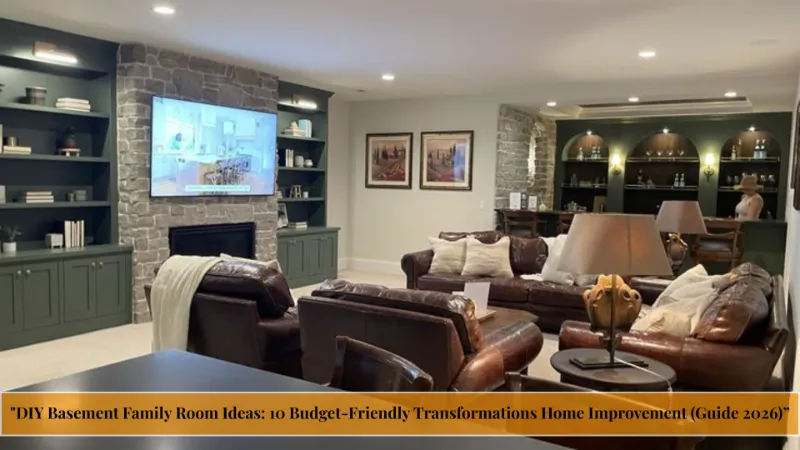
DIY Basement Family Room Ideas: 9 Budget-Friendly Transformations Home Improvement (Guide 2026)

You walk downstairs, flip the light switch, and see the same depressing sight: bare concrete walls, a sagging couch nobody uses, and boxes stacked from floor to ceiling. Sound familiar? Millions of homeowners are sitting on hundreds of square feet of untapped space right beneath their feet and doing absolutely nothing with it.
Here’s the truth: transforming your basement into a functional family room doesn’t require a $50,000 renovation budget or a team of contractors. With the right DIY basement family room ideas, smart planning, and a weekend-warrior attitude, you can create a stunning, livable space that your whole family will actually want to spend time in. This guide gives you 10 deeply practical, budget-friendly basement renovation ideas with real steps, real costs, and real results.
Whether you’re dealing with a low ceiling, poor lighting, moisture issues, or just a blank canvas of concrete, we’ve got you covered. Let’s turn that forgotten square footage into your home’s new favorite hangout spot.
Why Your Basement Is Your Home’s Biggest Opportunity
Real estate agents consistently say that finished basements increase home resale value by 70–75% of the renovation cost making it one of the highest-return DIY home improvement projects you can tackle. Unlike a kitchen or bathroom remodel, a basement family room conversion gives you a blank slate: no existing tile to rip out, no load-bearing walls to worry about (usually), and full freedom to design the space you actually need.
The average American basement holds around 800–1,200 square feet of unfinished space. At even $100/sq ft finished value, that’s potentially $80,000–$120,000 of added living space you could unlock on a $3,000–$8,000 DIY budget. The math is compelling. Beyond investment, a finished basement living space solves real daily problems: kids need a playroom, teens need their own hangout, adults need a movie room, and everyone needs more storage.
✦ Featured Snippet Answer
What is the cheapest way to finish a basement for a family room? The cheapest approach combines peel-and-stick flooring ($1–2/sq ft), paint-grade drywall panels ($0.50–0.80/sq ft), and plug-in LED lighting strings. A 400 sq ft basement can be transformed into a functional family room for as little as $2,000–$3,500 in materials with full DIY labor.
Before You Start: Essential Basement Prep Steps
No basement renovation idea survives first contact with moisture. Before you buy a single sheet of drywall, spend one weekend doing a proper moisture test. Tape a square of plastic sheeting to your concrete floor and walls, seal the edges with tape, and leave it for 24–48 hours. If condensation appears underneath the plastic, you have ground moisture that must be addressed before any finishing work. If condensation appears on top, it’s just humidity manageable with a dehumidifier.
Also check your ceiling height. Building codes in most U.S. states require a minimum of 7 feet of ceiling clearance for finished living spaces. If you’re at 6’8″, you may need to investigate lowering your concrete slab a major project. But if you’re at 7’2″ or more, you’re golden. Finally, note the location of your electrical panel, HVAC ducts, and water heater before planning your layout.
💡 Pro Prep Tip:
Before any work, photograph every pipe, duct, and wire in your unfinished basement. These photos will save you from accidentally drilling into something important during the build-out. Store them in a dedicated folder on your phone.
Drywall & Paint: The Instant Basement Transformation
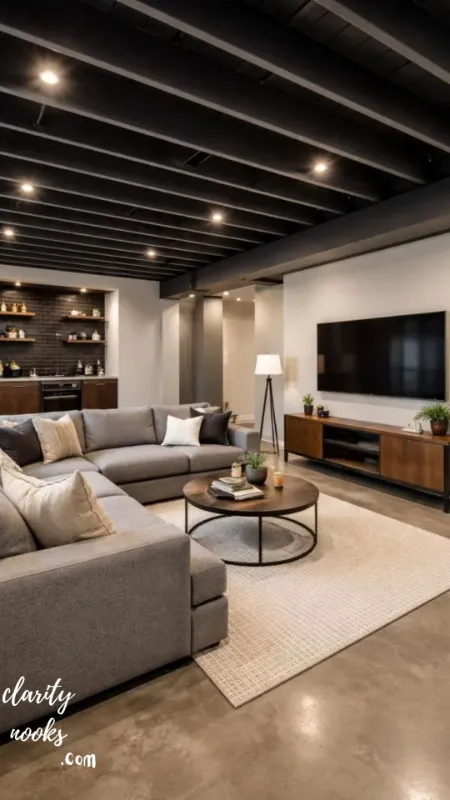
The single most impactful thing you can do for a finished basement family room is cover those cold concrete walls. Framing and drywalling your basement transforms it from a storage dungeon into a real room instantly warmer, quieter, and more livable. It sounds intimidating, but if you’ve ever assembled IKEA furniture, you have enough patience and skill to do this.
Cost
$800–$2,500
Skill Level
Beginner–Mid
Time
2–3 weekends
ROI
Very High
Materials Needed
2×4 lumber for framing, drywall sheets (moisture-resistant “green board” for basements), drywall screws, joint compound, primer, and your chosen interior paint color. For a typical 400 sq ft basement, budget around 60–80 sheets of drywall.
Step-by-Step Process
- Frame the walls using 2×4 lumber, keeping a 1-inch gap between the frame and concrete to prevent moisture transfer.
- Run any electrical wiring through the framed walls before closing them up this is the time to add outlets and switch boxes.
- Hang moisture-resistant drywall sheets using drywall screws, staggering seams for strength.
- Tape seams, apply joint compound in two to three thin coats, sanding between each.
- Prime with a quality moisture-blocking primer, then paint in two coats with your chosen color.
Decorating Tip:
For basement family room color ideas, choose lighter, warmer tones like soft greige, warm white, or pale sage. These reflect the limited natural light and make the space feel larger. Avoid stark white it reads cold underground.
The Rodriguez Family, Denver, CO
Maria Rodriguez tackled her 600 sq ft unfinished basement solo over three weekends. Total material cost: $1,840. She chose a warm “Accessible Beige” from Sherwin-Williams for the walls and crisp white for the ceiling. Her neighbors estimated the finished product looked like a $15,000 professional job.
Her biggest lesson:
“Rent the drywall lift. I thought I could hang sheets with my husband. We lasted 20 minutes before renting the lift it changed everything.”
Related Article: DIY Family Room Ideas: 10 Budget-Friendly Transformations That Actually Work
Basement Flooring Makeover: From Concrete to Cozy
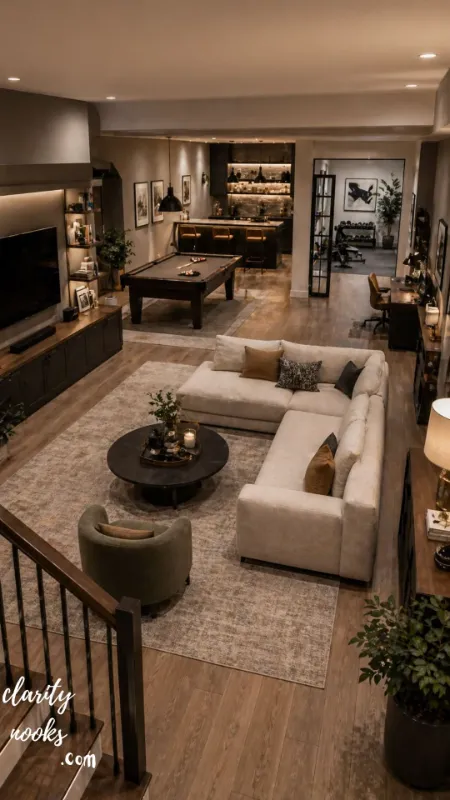
Basement flooring is the second biggest transformation you can make, and the options in 2026 are dramatically better than even five years ago. The key challenge is moisture you need flooring that can handle occasional dampness without warping, buckling, or growing mold. Fortunately, modern luxury vinyl plank (LVP) flooring and waterproof laminate were practically designed for basements.
Cost
$1–$6/sq ft
Skill Level
Beginner–Mid
Time
1 weekend
Best Option
LVP Flooring
Luxury vinyl plank flooring costs $2–4 per square foot installed by yourself, looks like real hardwood, and is 100% waterproof. It clicks together like puzzle pieces no glue, no nails, no professional required. For a cozy basement family room, pair LVP with a large area rug to add warmth and define zones. The rug also solves the acoustic problem of hard floors in enclosed spaces.
💡 Flooring Tip:
Always install a vapor barrier under any flooring in a basement even “waterproof” LVP. A 6-mil plastic sheeting under the planks costs about $0.10/sq ft and protects against ground moisture rising through the concrete slab.
Also Read: DIY Living Room Carpet Ideas: Transform Your Space Without Breaking the Bank
Layered Accent Lighting: Solving the #1 Basement Problem
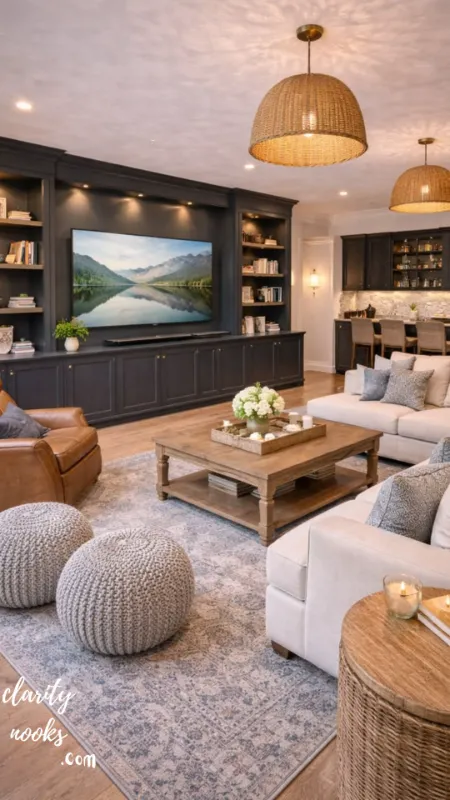
The number one reason finished basements feel depressing is bad lighting. A single overhead fixture casting flat, harsh light is the decorating equivalent of fluorescent hospital lighting. The solution is layered basement lighting design combining ambient, task, and accent lighting to create warmth, depth, and flexibility. This is one of the most impactful cheap basement finishing ideas because it doesn’t require rewiring most of it plugs in.
Cost
$150–$600
Skill Level
Beginner
Time
1 afternoon
Impact
Transformative
- Install recessed LED can lights as your base ambient layer they sit flush with the ceiling and don’t eat into your precious headroom.
- Add LED strip lights behind the TV unit, under floating shelves, or along crown molding for warm backlight glow.
- Place floor lamps in corners to push light upward and soften the space especially near seating areas.
- Use smart bulbs (Philips Hue or IKEA Tradfri) to set different moods for movie nights, playtime, or game days.
✦ Design Insight:
Lighting at 2700K–3000K color temperature creates a warm, golden ambiance ideal for a family room. Avoid 5000K+ daylight bulbs underground they feel clinical and harsh in a windowless space.
Must Read: Trendy DIY Living Room Curtain Ideas for a Fresh and Elegant Look
DIY Built-In Storage Walls: The Organization Game-Changer
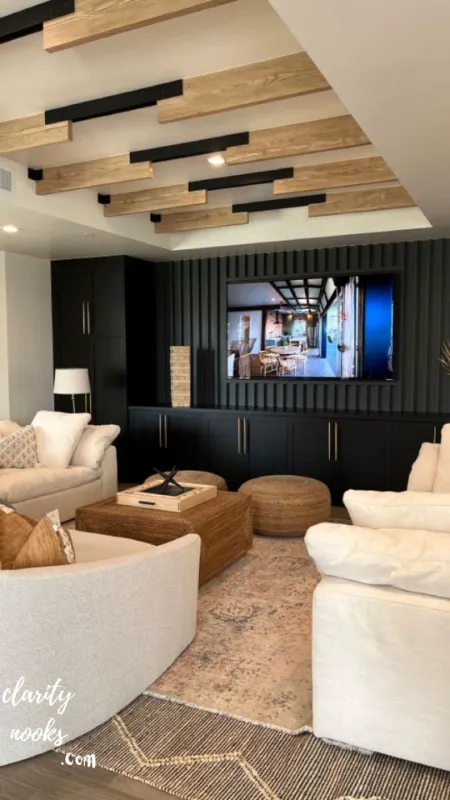
One of the most elegant basement family room storage ideas is a full-wall built-in unit the kind that looks custom but costs a fraction of bespoke cabinetry. The secret? IKEA KALLAX or BILLY bookcases, anchored to the wall and wrapped with trim and a continuous top shelf to look seamlessly built-in. Interior designers call this the “IKEA hack” that costs $600 and looks like $6,000.
Cost
$400–$1,200
Skill Level
Beginner
Time
1–2 weekends
Storage Gain
Massive
Arrange a row of KALLAX units side by side, fill gaps with baseboard trim, and add a floating top shelf across the entire wall. Paint everything the same color as the wall for a truly seamless look. Use the lower cubbies for wicker baskets and bins to hide kids’ toys, board games, and DVD collections while the upper shelves display books, plants, and decor.
💡 Stability Tip:
Always anchor your storage units to wall studs with heavy-duty L-brackets. In a basement family room with active kids, unsecured furniture is a safety hazard and a legal liability if children are injured.
Don’t Miss: DIY Living Room Decor Ideas That Actually Transform Your Space
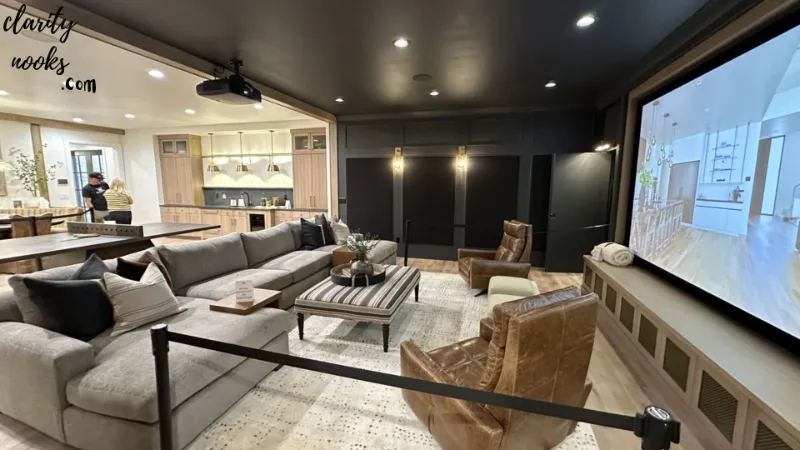
DIY Basement Movie Theater Nook: Your Personal Cinema
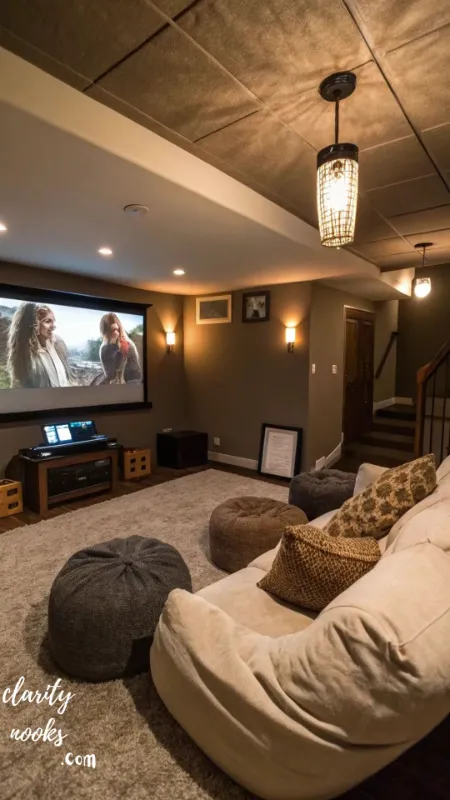
A basement home theater room is consistently the most-requested basement family room feature and for good reason. Basements are naturally dark, naturally quiet (below-grade walls absorb sound), and naturally climate-controlled. These are exactly the conditions professional movie theaters engineer at enormous expense. You already have them for free.
Cost
$500–$2,000
Skill Level
Beginner
Time
1 weekend
WOW Factor
Extreme
- Mount a 100″–120″ projector screen (or use a white painted wall with grey paint border) a 120″ fixed-frame screen costs $80–200 on Amazon.
- Choose a short-throw 4K projector the BenQ TH585 or Optoma HD146X offer outstanding performance for under $600.
- Install tiered seating using a simple 8″ raised platform built from 2×4 lumber and plywood, covered with matching carpet. Place the back row on the platform for unobstructed sightlines.
- Add acoustic panels on side walls DIY versions with rockwool insulation wrapped in fabric cost $15–20 each and dramatically improve sound quality.
- Finish with a Dolby Atmos soundbar ($200–400) and your home theater rivals any multiplex.
Real-Life Example
James & Carol, Minneapolis, MN
This couple built a 6-seat basement theater for $1,340 total. They made their own tiered platform from leftover framing lumber, painted the back wall with “Screen Paint” (available at hardware stores), and sourced theater-style seats from Facebook Marketplace for $120 for a pair. “We haven’t been to an actual movie theater in 18 months,” James reports. “Why would we?”
Trending Posts: Modern DIY Bedroom Curtain Ideas for a Beautiful Home Interior Look
Kids’ Play Zone Corner: Contained Chaos That Works
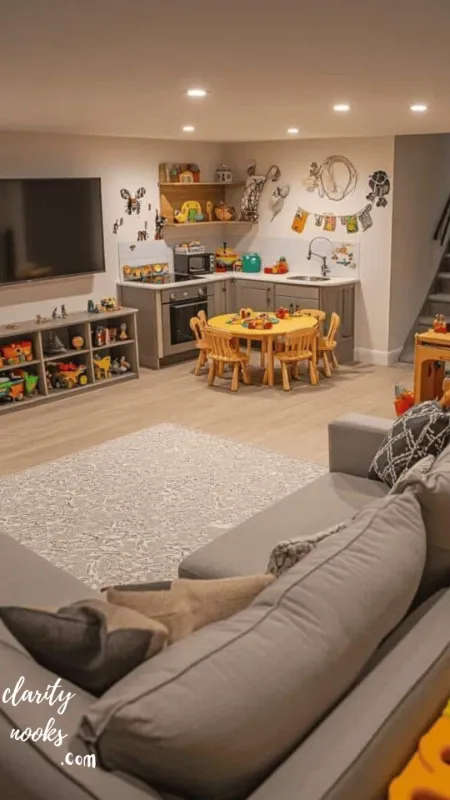
If you have children between ages 2–12, dedicating a defined zone of your basement family room to a kids’ play area is one of the smartest layout decisions you can make. It keeps the mess contained, gives children their own sense of ownership, and lets adults actually relax in the same room. The goal is visual containment without physical walls.
Cost
$200–$700
Skill Level
Beginner
Time
1 day
Sanity Saved
Priceless
Define the zone with interlocking foam play mat tiles ($40–80 for a 10’x10′ area) instead of permanent flooring they protect kids from the hard floor and visually delineate the space. Add a low KALLAX shelf at kid-height with labeled bins, a small chalkboard wall panel (just chalk paint on a section of drywall), and string lights overhead to make it feel magical. Keep adult seating at the zone’s edge so parents can supervise without hovering.
💡 Safety Tip:
Always anchor bookshelves and storage units to the wall in a kids’ play area this is non-negotiable from a furniture tip-over safety standpoint. Use IKEA KURA-style anti-tip straps on all freestanding furniture.
Reader Like This: Creative DIY Beach Bedroom Ideas for a Cozy Nautical Style Bedroom
Shiplap & Accent Walls: Instant Character & Warmth
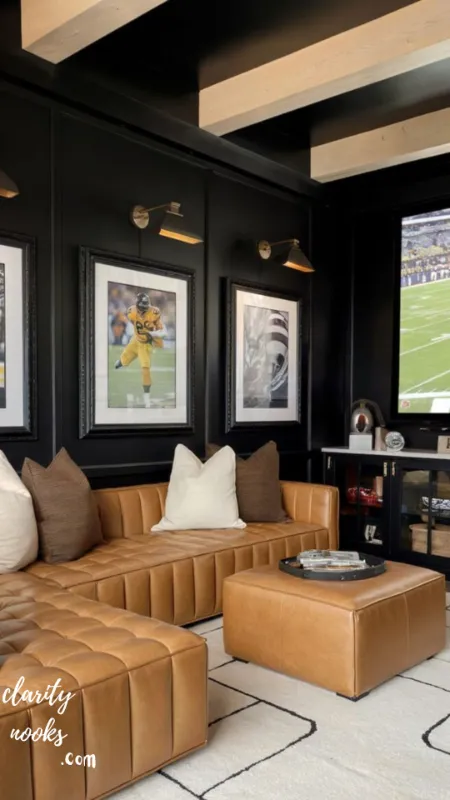
Shiplap accent walls are having a well-deserved moment in basement interior design. A single accent wall in a living space especially one behind the TV or at the base of the stairs adds enormous character, texture, and perceived value without touching the rest of the room. And unlike full-wall renovations, an accent wall is a weekend project even for beginners.
Cost
$150–$400
Skill Level
Beginner
Time
1 weekend
Impact
High
For a DIY shiplap wall, use 1×6 pine boards ($0.80–1.20/linear foot) or pre-primed shiplap planks from your local home improvement store. Install a moisture barrier first, then nail the planks horizontally with a nickel-width gap between each. Paint in a bold charcoal, warm navy, or deep forest green for a statement look, or crisp white for a farmhouse-style aesthetic. Either way, the texture alone elevates the space dramatically.
✦ Alternative Option
Peel-and-stick wood panels from brands like Stikwood offer a renter-friendly alternative that installs in hours with no nailing, cutting, or primer. Cost is higher ($8–12/sq ft) but the time savings are significant for smaller accent walls.
Drop Ceiling Tile Makeover: Don’t Hide It Own It
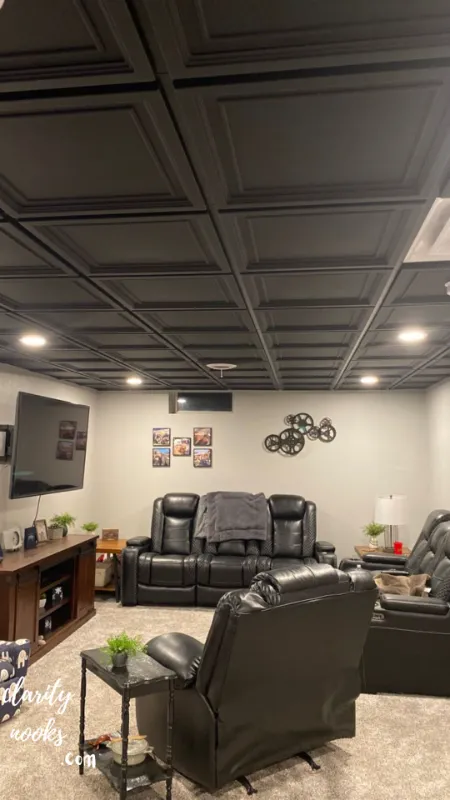
Drop ceilings in basements are a necessary evil in most homes they hide pipes, ducts, and wiring while keeping access open. But they don’t have to look like a 1980s office. Modern basement ceiling ideas work with the drop ceiling grid rather than against it, turning functional necessity into a design feature. The result can look genuinely upscale for very little money.
Cost
$200–$600
Skill Level
Beginner
Time
2–3 days
Impact
High
Option A: Replace standard white 2×2 tiles with decorative mineral fiber tiles (tin-look, coffered, or geometric patterns) available at home improvement stores for $1–3 per tile. Option B: Paint your existing tiles with spray paint designed for ceiling tiles matte black drop ceilings are having a serious moment and make the room feel taller and more dramatic, not smaller. Option C: Ditch the tiles entirely and use the grid to hang lightweight wooden planks or fabric panels for a completely custom look.
💡 Height Tip:
Painting your drop ceiling black and then choosing light-colored walls creates an optical illusion that makes the ceiling “disappear” making the room feel significantly taller than it actually is. This is a professional interior design trick used in restaurants and boutique hotels.
Flexible Multi-Zone Layout: One Basement, Three Functions
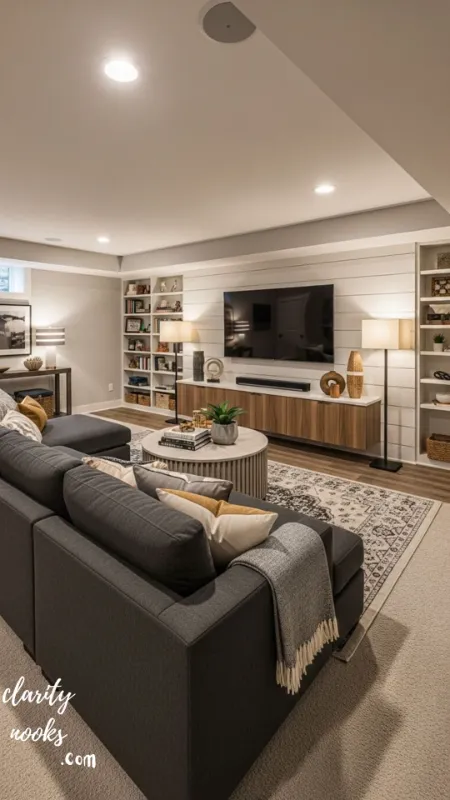
The most sophisticated basement family room layout idea for 2026 isn’t a single-purpose room it’s a thoughtfully divided multi-zone space that serves your whole family without needing walls. Using furniture arrangement, area rugs, lighting, and strategic storage, you can carve a media zone, play zone, and adult lounge out of a single open basement without spending a penny on walls or permits.
Cost
$500–$2,000
Skill Level
Beginner
Time
1–2 days
Flexibility
Maximum
The key tools for open-plan basement room division are: oversized area rugs (one per zone, different textures), a bookcase or storage unit as a room divider (KALLAX units work perfectly here, open on both sides), varied ceiling heights created with box beam accents, and distinct lighting zones with separate switches or smart controls. When each zone has its own rug, lighting identity, and furniture cluster, the brain registers distinct “rooms” even without physical separation.
✦ Layout Formula
For a 700 sq ft basement: Zone 1 (40%) = Media/Theater. Zone 2 (30%) = Kids Play. Zone 3 (20%) = Adult Lounge. Zone 4 (10%) = Storage/Utility. Use a floating KALLAX shelf unit to divide Zone 1 from Zone 2, and matching area rugs to anchor each space.
Conclusion
Transforming your basement into a stunning DIY family room is one of the most rewarding, highest-ROI home improvement projects you can tackle. With the right basement family room ideas, even a complete beginner can go from bare concrete to a cozy, functional living space for under $5,000 in materials and a few dedicated weekends of work.
Start with moisture control, choose waterproof flooring, layer your lighting, and use furniture and rugs to define distinct zones. The results will surprise you and your family will thank you. The most important step? Starting.
Trend Analysis: Basement Family Room Design in 2026–2028
Trend Watch
The way homeowners approach basement renovation and design is shifting in meaningful ways. Three years of post-pandemic remote work have redefined how families use every room in the home and basements have been one of the biggest beneficiaries. Understanding where trends are heading helps you make future-proof design decisions today.
2026 — Now
The “Soft Life” Basement
Deep, plush textures bouclé sofas, chunky knit throws, shag area rugs, arched furniture forms. Anti-sharp-corner, maximally comfortable aesthetics dominating basement family rooms.
2026 — Now
Biophilic Basement Design
Bringing nature underground via grow lights, trailing plant walls, natural stone accents, rattan furniture, and earthy color palettes. Combats the “underground” feel psychologically.
2027 →
Smart Basement Integration
Whole-home smart systems extending into basements: voice-controlled multi-zone lighting, automated climate, motorized projector screens, and integrated speaker systems becoming mainstream.
2027–2028 →
ADU-Ready Basements
With housing costs soaring, homeowners are future-proofing basements as Accessory Dwelling Units rough plumbing, egress windows, separate entrances while still functioning as family rooms today.
2028 →
Wellness Zones Underground
Infrared saunas, cold plunge stations, meditation nooks, and dedicated fitness corners are the next evolution of basement family rooms for health-conscious homeowners.
2026–2028 →
Sustainable Materials
Reclaimed wood, recycled glass tiles, cork flooring, and VOC-free paints are becoming non-negotiable for environmentally conscious homeowners in all basement renovations.
Expert Insights: 6 Professional Tips Most DIYers Miss
Pro Knowledge
After dozens of conversations with interior designers, contractors, and experienced DIYers, these are the insights that separate truly great basement family rooms from ones that feel “almost there.”
🎨 Paint the ceiling last, not first
Most DIYers paint the ceiling first, then the walls. Professional painters go the opposite direction for good reason: it’s much easier to cut-in walls along a painted ceiling than the reverse. In basements with exposed joists you’re painting, work systematically from the back of the room toward the stairs.
💡 Install 20% more outlets than you think you need
The most common complaint from homeowners six months after a basement renovation: “I wish I’d added more electrical outlets.” Rough-in electrical work costs roughly $35–50 per additional outlet when done during a renovation versus $150+ to add them after drywall is up. Budget for outlets every 6 feet on all walls.
🔊 Soundproofing is a two-way investment
Basement soundproofing isn’t just about keeping the music in it’s about keeping the kids’ noise out of the main living areas above. Add Roxul Safe ‘n’ Sound insulation between ceiling joists before drywalling for a 40–50% noise reduction. It costs about $0.80/sq ft and dramatically improves the quality of life for the whole household.
📐 Design around the obstacles, not against them
That beam running across the center of your basement? Build a coffered detail around it. The support pole in the middle of the room? Wrap it in shiplap or stone veneer and make it a feature. The best basement design hacks transform structural necessities into design opportunities rather than hiding them awkwardly.
🌡️ Insulate the rim joists not just the walls
The rim joist area (where your floor framing meets the foundation walls) is responsible for up to 15–20% of a home’s heat loss. Insulating these with spray foam or rigid foam insulation before finishing your basement dramatically improves comfort and reduces energy bills yet fewer than 30% of DIYers do it.
📏 Measure for furniture before buying it
Basements often have narrow stairwells, low ceilings, and tight corners. That gorgeous sectional sofa may physically not fit down your stairs. Always measure your stairway opening (width, height, landing clearance) before purchasing any large furniture. Many homeowners have discovered this heartbreaking truth on delivery day.
Long-Term Strategy: Building a Basement That Grows With You
Smart Planning
The most valuable approach to basement family room design is thinking in phases. Rather than trying to do everything at once with a tight budget, plan your renovation in three distinct phases: Foundation (moisture control, insulation, flooring, basic lighting), Functionality (walls, storage, entertainment setup), and Finishing (decorating, accent pieces, smart home tech). Each phase builds on the last and can be done months or years apart.
Think about flexible design choices that allow the room to evolve. A kids’ play zone becomes a teen hangout in eight years, which becomes a home office or guest suite in fifteen. Choosing neutral, durable materials for your permanent elements floors, walls, ceilings while using easily-swapped furnishings for zone-specific character gives you a space that adapts without requiring a full re-do.
✦ Long-Term Value Insight
According to NAR (National Association of Realtors) data, finished basements recoup 70–80% of renovation costs at resale but only when they’re finished to a comparable standard as the rest of the home. Cutting corners on moisture control, electrical, and ceiling height to save money can actually hurt resale value more than leaving the basement unfinished.
Future Predictions: What Basement Design Looks Like in 2028+
Future Forward
The next 2–3 years in basement home renovation will be shaped by three major forces: housing cost pressures driving ADU conversions, AI-powered smart home integration, and the continued blurring of indoor/outdoor living concepts.
Homeowners who are building or renovating basements today should consider rough-in plumbing for potential wet bar or bathroom additions, pre-wiring for whole-home audio/video systems, and ceiling-height clearances that comply with ADU regulations even if an ADU isn’t the immediate plan.
AI home design tools are already changing how homeowners plan renovations. Platforms like RoomGPT and AI-powered apps let you upload a photo of your unfinished basement and generate photorealistic finished versions in dozens of styles in seconds. This dramatically reduces the planning guesswork that historically led to expensive mid-project redesigns. Expect these tools to become standard in the renovation planning process by 2027.
Common Mistakes & Hidden Gaps: What to Avoid
Avoid These
Even experienced DIYers make costly mistakes when finishing a basement family room. These are the most common and most expensive errors to avoid:
✕ Skipping the moisture test before any work
Starting framing or flooring on a basement with active moisture is the most expensive mistake you can make. A $5 plastic sheet test and 48 hours of patience can save you thousands in mold remediation and torn-out drywall later.
✕ Using standard drywall instead of moisture-resistant
Regular “whiteboard” drywall has a paper face that’s a mold-growth highway underground. Always specify Type X or moisture-resistant “purple board” or “green board” for basement applications the price premium is minimal, the protection is significant.
✕ Forgetting egress requirements
If your basement renovation includes a bedroom or sleeping area, most building codes require an egress window meeting specific size requirements (typically at least 5.7 sq ft of opening). Skipping this is not only a code violation it’s a serious fire safety issue.
✕ Choosing wall-to-wall carpeting
Carpeting in a basement while cozy-feeling is a moisture and mold trap waiting to happen. Even one flooding event (burst pipe, heavy rain) can render carpet unrepairable. Always choose hard, waterproof flooring (LVP, tile) with area rugs for warmth and softness.
✕ Buying furniture before checking stairway dimensions
Many first-time basement renovators discover on delivery day that their beautiful sectional sofa cannot navigate the staircase. Always measure your stair opening, railing height, and landing clearance before making any large furniture purchases.
✕ Ignoring permits to “save time”
Unpermitted basement work can cause serious problems at resale buyers’ lenders may refuse to appraise unpermitted spaces, and you may face costly tear-down orders from local building departments. Check your municipality’s requirements before starting any structural, electrical, or plumbing work.
Frequently Asked Questions: DIY Basement Family Room Ideas
How much does it cost to DIY finish a basement family room?
A basic DIY basement family room conversion typically costs $3,000–$8,000 in materials for a 400–600 sq ft space, depending on material choices and scope. Hiring everything out runs $25,000–$75,000 for the same footprint. The DIY savings are enormous typically 60–75% of total cost making this one of the highest-value home improvement projects available to handy homeowners.
Do I need a permit to finish my basement?
Most municipalities require permits for any work involving structural changes, electrical work, plumbing, or HVAC modifications. Cosmetic changes (painting, flooring on existing concrete, adding rugs and furniture) typically don’t require permits. Always check with your local building department before starting requirements vary significantly by city and state.
What flooring is best for a basement family room?
Luxury vinyl plank (LVP) is the near-universal top recommendation for basements because it’s 100% waterproof, comfortable underfoot, visually resembles hardwood or stone, and installs as a DIY floating floor without adhesive. Ceramic and porcelain tile are excellent alternatives. Wall-to-wall carpet should be avoided due to moisture and mold risk.
How do I make a dark, low-ceiling basement feel bigger?
Four strategies work together powerfully: (1) paint the ceiling dark (matte black makes it “disappear”), (2) choose lighter, warmer wall colors, (3) use layered lighting with uplighting in corners and warm under-shelf LED strips, and (4) avoid heavy, tall furniture keep pieces low and leggy to preserve visual headspace.
What is the best way to insulate a basement for a family room?
The most effective combination is: spray foam insulation at rim joists for air sealing (most impactful per dollar), rigid foam insulation board (2″ XPS) against concrete foundation walls for thermal protection, and standard batt insulation in framed wall cavities. This triple approach addresses conduction, convection, and air infiltration the three heat-loss paths in a basement.
How do I soundproof a basement family room on a budget?
The most budget-effective approach is Roxul/Rockwool Safe ‘n’ Sound mineral fiber insulation in ceiling joists ($0.75–1.00/sq ft) before drywalling. Add mass-loaded vinyl behind drywall on shared walls for additional sound dampening. Area rugs, upholstered furniture, and acoustic panels also absorb sound within the space itself, reducing echo and liveliness.
Rameen Zara is the founder of Clarity Nooks, bringing over five years of experience in home décor and interior styling. She shares simple yet practical design ideas that suit real homes and everyday living. Her approach focuses on cozy aesthetics, soft color palettes, and natural textures that create warm, inviting spaces.